The Execution Gap Is Not a Strategy Problem
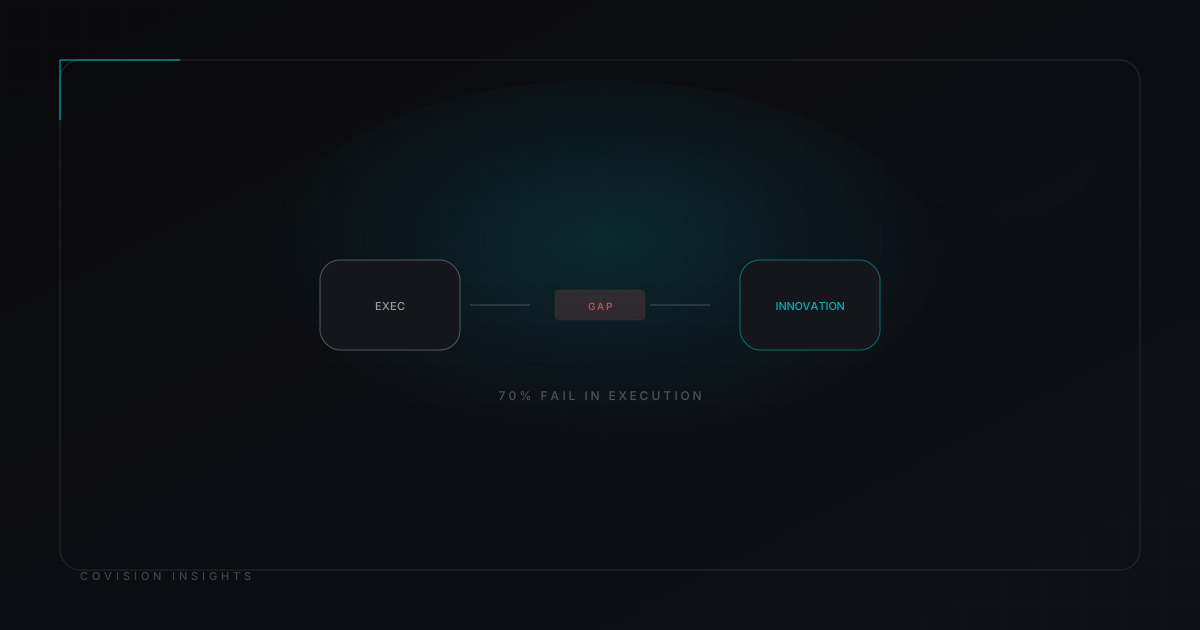
Bain & Company's research consistently finds that roughly 60% of corporate strategies fail to achieve their intended outcomes. McKinsey data puts the figure higher, estimating that only 26% of transformation initiatives deliver their stated targets at scale. The conventional diagnosis is poor strategy. The more accurate diagnosis is poor translation.
The strategies themselves are often coherent. The problem is what happens between the strategy document and the people expected to execute it, and nowhere is this translation failure more costly than in the relationship between executive leadership and innovation teams.
Innovation teams operate in a language of possibility. They discuss potential markets, emerging technologies, future customer behaviours, and the conditions that might make a concept viable in three to five years. This language is appropriate for early-stage exploration. It is not the language of executive decision-making.
Executives operate in a language of commitment. They need to know what return a given investment will generate, over what time horizon, against what alternatives, and with what confidence level. When innovation teams present possibility to executives expecting commitment, the result is not a conversation, it is a mutual performance of engagement that produces no decision.
The strategic alignment gap is the structural distance between these two communication modes.
Three Patterns of Misalignment
Pattern One: The Infinite Horizon Trap
Innovation teams habitually qualify their projections with long time horizons. "In five to seven years, this market could reach X." Executives hear the qualifier and discount the claim entirely, because any projection beyond 18 months is, in their experience, a forecast with no accountability attached.
The alignment failure is not about the accuracy of the projection, it is about the framing. A five-year market opportunity is a valid input. Presented without a clear 12-month action and an accountable owner, it registers as aspiration, not analysis.
Pattern Two: The Potential Vocabulary
Innovation teams use the word "potential" frequently. It is an honest word, innovation is by definition uncertain. But in executive contexts, "potential" translates directly to "not yet real", which translates to "not yet worth resourcing."
The equivalent executive vocabulary is "return". Not "this concept has significant potential" but "this concept is likely to generate [specific return] under [specific conditions] if [specific assumptions] are correct." The second formulation gives an executive something to interrogate and, crucially, something to fund.
Pattern Three: The Complexity Penalty
Innovation teams produce detailed, nuanced work. They understand the technology dependencies, the market dynamics, the regulatory environment, and the competitive context. They present this complexity in full, under the reasonable assumption that thoroughness signals credibility.
The effect is the opposite. Executives who receive a 40-slide deck from an innovation team in a 20-minute slot are receiving a cognitive demand they cannot meet in that context. The complexity penalty is real: presentations that exceed the executive's processing capacity in the time available produce scepticism, not confidence.
Three Communication Protocols
These are not persuasion tactics. They are structural formats that reduce translation loss between the two communication modes.
Protocol One: The Three-Sentence Brief
Every concept, regardless of complexity, must be reducible to three sentences:
- The problem sentence: "[Specific customer type] currently cannot [specific job to be done] because [specific barrier]. This costs them [specific quantified consequence]."
- The solution sentence: "We propose [specific intervention] that enables [specific customer type] to [achieve specific outcome] in [specific timeframe]."
- The return sentence: "If the core assumption, [single most important belief that must be true], holds, the business generates [specific return metric] by [specific date], with a [specific capital requirement] to reach that point."
The three-sentence brief is not a substitute for a full analysis. It is the entry point that determines whether the executive engages with the full analysis at all. Briefs that cannot be reduced to this format typically have an upstream clarity problem that the brief reveals.
Protocol Two: Risk-First Framing
The instinct in innovation communication is to lead with the opportunity. This is structurally counterproductive in executive contexts, where any opportunity claim triggers an immediate, often unspoken search for the risk. If the presenter does not address risk early, the executive spends the presentation in adversarial posture, looking for the gap rather than engaging with the substance.
Risk-first framing inverts the structure:
- The two or three things that could cause this to fail, stated explicitly.
- What evidence would reduce each risk.
- What the plan is to generate that evidence.
- The opportunity, given that risk posture.
This format is counterintuitive but significantly more effective. It demonstrates analytical rigour, gives executives the risk register they are already building mentally, and positions the innovation team as a credible assessor rather than an advocate.
Protocol Three: The Visual Venture Map
The most durable communication format for innovation concepts is spatial rather than sequential. A visual venture map places the concept in the context of:
- Market position: where the concept sits relative to existing business lines and competitive alternatives
- Investment stage: how much has been spent, how much more is required, and what that buys
- Assumption status: which key assumptions have been tested, which have not, and what the testing plan is
- Risk exposure: which dimensions carry the highest uncertainty at this point in development
A visual venture map can be reviewed in 90 seconds. It does not replace a detailed briefing document, it makes a detailed briefing document worth reading by demonstrating that the team has a structured view of where they are.
How Structured Outputs Bridge the Gap
The alignment gap is partly a cultural problem, but it is also a process problem. When innovation sessions produce unstructured outputs, lists of ideas, summary notes, rough concepts, each output requires a translation step before it can be presented to executive leadership. That translation step is expensive, introduces distortion, and is typically performed under time pressure.
Structured outputs, concept briefs with defined fields, risk-rated portfolios, visual venture maps, can be presented directly to executives without translation. The format is already in a language that connects to capital allocation and decision-making.
The discipline of producing structured outputs during a workshop, rather than afterward, is what distinguishes programmes that generate executive traction from programmes that generate executive fatigue. When ideas emerge as briefs rather than notes, the communication protocol is embedded in the process.
This is where platforms like CoVision create leverage. By structuring concept capture in real time during a workshop session, the output the room produces is the brief the executive receives, without a secondary processing phase and without translation loss.
The Measurement of Alignment
Strategic alignment is measurable, though most organisations do not measure it. The relevant metrics are:
- Decision velocity: the average time from concept presentation to executive decision (fund, kill, or pilot)
- Translation cycles: the average number of revisions a concept brief requires before an executive will act on it
- Sponsorship rate: the proportion of innovation concepts that acquire an executive sponsor within 30 days of presentation
- Follow-through rate: the proportion of workshop-generated concepts that result in funded activity within 90 days
Organisations that close the alignment gap see decision velocity improve first. The time-to-decision collapses when executives receive structured briefs in their language, because they do not need additional rounds of clarification before they can form a view.
Programmes that are struggling with the alignment gap almost always have high translation cycles, concepts that require multiple revisions before an executive will engage with them. This is a process signal, not a talent signal. The fix is structural, not cultural.