The Async Experiment
Between 2020 and 2023, enterprise innovation teams ran what amounts to an involuntary large-scale experiment in async ideation. Distributed working forced organisations to replace co-located workshops with digital collaboration tools: shared whiteboards, document comment threads, asynchronous video responses, and persistent innovation channels.
The tools improved significantly over this period. Async collaboration platforms became more sophisticated, more visual, and more capable of organising distributed input.
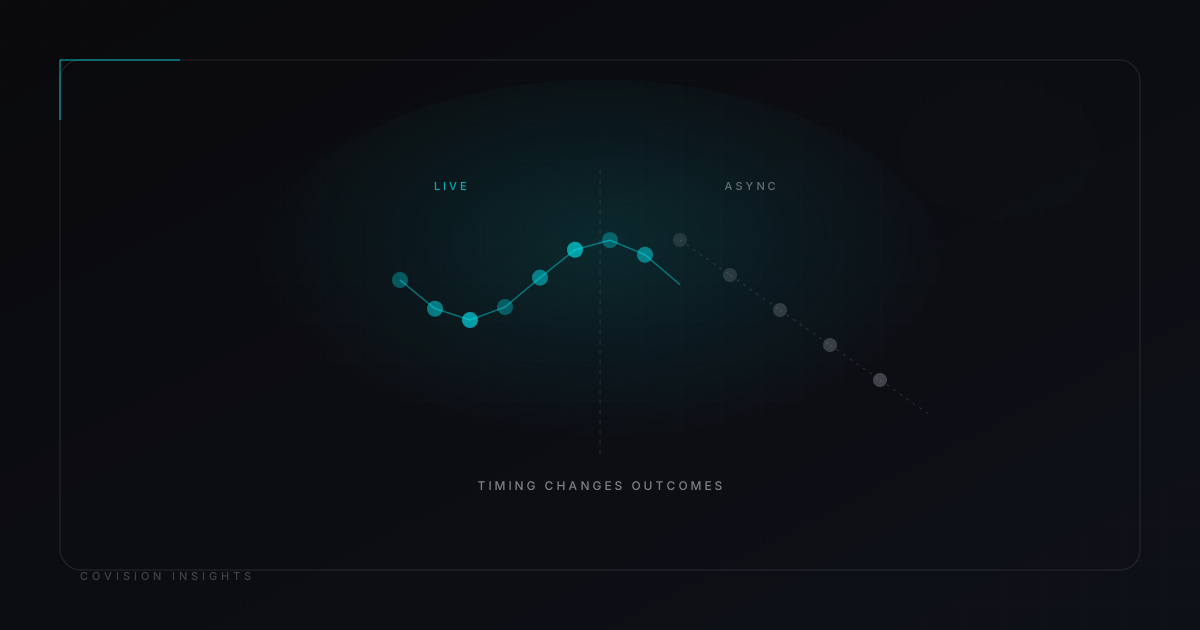
The outcomes did not improve in proportion. If anything, the async experiment surfaced something that facilitation practitioners had long suspected but could not easily demonstrate: that the mode of ideation matters as much as the quality of the ideas generated within it. For strategic decisions specifically, async innovation frameworks have significant and predictable failure modes that real-time formats do not share.
What Async Actually Does to Signal Quality
The appeal of async ideation is rational: it removes scheduling constraints, gives introverted participants space to think, allows people to contribute in their own time, and creates a written record of contributions without requiring dedicated note-taking.
These are genuine advantages for certain types of collaborative work. They are not advantages for strategic alignment decisions. Here is why.
Signal Fidelity Degrades Over Time
Ideas do not exist as static artefacts. They exist in context, the context of the conversation in which they were generated, the reasoning that led the contributor to that idea at that moment, the immediate responses of colleagues who were there to engage with it.
In async environments, that context is stripped away almost immediately. A contribution posted to a shared board on Monday exists, by Thursday, as an orphaned artifact, readable, but no longer surrounded by the social and conversational context that would allow colleagues to evaluate it properly.
Research by professor Paul Paulus at the University of Texas Arlington on group idea generation found that idea quality assessments were significantly more accurate when evaluators had access to the context in which ideas were generated, including the discussion that surrounded them, than when they evaluated ideas from written records alone. The assessment accuracy gap widened with the amount of time elapsed between generation and evaluation.
In strategic terms: the longer the gap between when an idea is generated and when it is evaluated, the more likely the evaluation is to be wrong.
Async Loses the Productive Conflict
One of the most undervalued outputs of real-time ideation is productive conflict, the moment when two participants with genuinely different strategic views engage directly, in real time, and are forced to either update their positions or articulate their reasoning more precisely.
This kind of conflict produces decision insight that cannot be replicated in async formats. When participant A posts an idea and participant B responds with a critique three days later, the exchange lacks the energy, pressure, and mutual attention that produces genuine position updates. Participants can note the disagreement. They rarely resolve it.
Strategic alignment decisions that contain unresolved disagreements, the ones where participants have noted different views but haven't engaged with them, consistently produce lower implementation follow-through. The alignment is nominal, not real.
Async Enables Strategic Avoidance
Perhaps the most organisationally significant failure mode of async innovation frameworks is the ease with which they enable strategic avoidance. In an async environment, a senior participant who is uncomfortable with a proposed direction can simply not respond. The discomfort is not surfaced. The disagreement is not resolved. The consensus that forms in the absence of their engagement is not real consensus.
In a real-time session, non-engagement is visible. A facilitator who sees the head of Finance sitting silent during a discussion about a major resource reallocation can bring them in explicitly. The discomfort is surfaced. The real position is elicited.
Async tools have no equivalent mechanism. The silent non-response looks identical to considered agreement.
When Async Ideation Does Work
Async frameworks are not uniformly inferior. They outperform real-time formats in specific and predictable circumstances.
Early-stage exploration: When the goal is wide divergence of perspectives without pressure to converge, async allows participants to contribute without anchoring to each other's ideas. This is valuable in the earliest stages of problem framing, where premature convergence is a genuine risk.
Complex technical input: When contributions require significant individual expertise and preparation, technical architecture reviews, detailed market analyses, specialist regulatory assessment, async allows contributors to prepare properly rather than improvising in real time.
Geographically distributed teams across multiple time zones: Where real-time synchronous sessions are genuinely impractical, async is the realistic alternative. The signal degradation is a cost worth paying when the alternative is no engagement at all.
Post-session refinement: Async is highly effective as a follow-up mechanism after a real-time alignment session, for capturing additional thoughts, providing written endorsement of decisions, or refining outputs that were drafted in the session.
The pattern is clear: async works where the goal is divergence, depth, or accessibility. It fails where the goal is convergence, alignment, or decision.
The Psychology of Decision-Making Momentum
The decision-making research literature offers a consistent finding that has direct implications for innovation workshop design: decision quality correlates with the energy state of the participants at the moment of decision.
Groups that have been in active, engaged, real-time discussion for two to four hours, and are then asked to make a decision, demonstrate significantly higher decision quality, as measured by subsequent implementation rates and decision regret, than groups asked to make the same decision after a period of async reflection.
The explanation is partly cognitive: real-time discussion activates the reasoning processes needed for complex judgment in a way that async reflection does not. It is also partly social: decision momentum builds in real-time settings in ways that async formats structurally prevent.
This has a practical implication for enterprise innovation programmes that have shifted heavily toward async formats in the name of efficiency: the decisions that emerge from those formats may be systematically lower quality than the same decisions made in real-time sessions, regardless of how sophisticated the async tooling is.
The Specific Cost in Enterprise Innovation Programmes
Enterprise innovation programmes that rely primarily on async ideation tend to exhibit a specific pattern of failure that practitioners recognise but rarely diagnose correctly.
They generate volume without velocity. The async channels fill with contributions. The idea count looks impressive. The rate at which those ideas progress to funded, implemented initiatives is low, typically lower than comparable real-time programme formats.
The root cause is the alignment deficit. Ideas generated asynchronously, without the productive conflict and shared context of real-time engagement, tend to arrive at the prioritisation stage without the cross-functional alignment that allows them to move forward. They require a subsequent real-time session to generate the alignment that the async process didn't produce. That session is often the one that should have happened in the first place.
Closing: Designing for the Outcome You Actually Need
The choice between real-time and async ideation should be made based on the specific outcome required, not on logistical convenience or participant preference.
For strategic alignment decisions, the ones that will inform resource allocation, market positioning, organisational structure, or portfolio prioritisation, real-time ideation is not just preferable. The evidence suggests it is materially more likely to produce decisions that stick.
Designing a real-time alignment session for enterprise teams in 2026 requires infrastructure that can handle the synthesis demands of a large group in a single sitting. That is where async tools have genuinely excelled in comparison to traditional real-time formats, the async platforms made capture and organisation scalable in ways that physical whiteboards never could.
The goal is to combine the alignment advantages of real-time engagement with the capture and synthesis capabilities that modern platforms provide. Tools like CoVision are built for exactly this combination: structured real-time ideation with synthesis and output generation that happens during the session, not after it.
The async experiment produced useful tools and demonstrated real limitations. The enterprise innovation programmes that thrive in the next five years will be the ones that learned both lessons.