Why Workshops Fail Before They Produce Anything
The enterprise innovation workshop has become a standard tool in the corporate strategy repertoire. Most large organisations run several per year. A significant proportion of these sessions produce outputs that are never meaningfully acted on.
The causes are rarely opaque. The same seven structural mistakes appear with enough regularity across organisations and industries that they constitute a recognisable pattern, one that experienced facilitators can diagnose on arrival and that organisations can protect against with deliberate session design.
This article names each mistake precisely, describes the mechanism by which it kills momentum, and offers a specific structural countermeasure.
Mistake 1: No Pre-Work Brief
What it looks like: Participants receive a calendar invite, a room location, and an agenda title. They arrive at the session having done zero preparation, which means the first two hours of the day are consumed by context-setting that should have happened before anyone entered the building.
Why it kills momentum: Innovation sessions that begin with shared context-building produce outputs shaped by whoever speaks first and most confidently in the opening discussion. The participants who arrive with genuine prior thinking, who have been turning the problem over for days, have no structural advantage over those who are engaging with the problem for the first time. The result is surface-level ideation masquerading as strategic insight.
The countermeasure: Send a structured pre-work brief at least 48 hours before the session. The brief should include: the decision mandate (specific and actionable), two to three framing questions, relevant context materials (no more than ten pages), and an explicit ask, "come prepared with one idea you believe the group hasn't considered." Track engagement with the brief. Participants who haven't completed pre-work produce lower-quality first contributions.
Mistake 2: Too Many Participants, Too Few Constraints
What it looks like: The session invite expands to include stakeholders, observers, and anyone who expressed an interest. The facilitator, not wanting to exclude anyone, ends up running a session for 30 people with no clear decision-making mandate and too many competing priorities to resolve.
Why it kills momentum: Decision quality in group settings follows an inverted-U curve as group size increases. Research from organisational psychology, including studies by Richard Hackman at Harvard, consistently finds that groups larger than roughly eight to twelve members produce lower-quality decisions, not better ones, because the social dynamics of large groups suppress dissent, reward conformity, and make it structurally difficult for every perspective to receive genuine attention.
The countermeasure: Cap the session at 16 participants. If more stakeholders need to be engaged, design a two-stage process: a working group session produces the primary synthesis, and a broader stakeholder review session receives and responds to the output. Give each participant a clear role: contributor, reviewer, or observer. Observers should not be in the room, they dilute the decision-making energy without adding to it.
Mistake 3: Sticky Note Avalanche
What it looks like: The session opens with an invitation to generate ideas, "put everything on a sticky note." Fifty minutes later, there are 300 sticky notes on three walls. The room looks productive. Nobody knows what to do next.
Why it kills momentum: Unstructured volume is not useful output. It is a documentation problem that must be solved before synthesis can begin. The sticky note avalanche typically signals one of two facilitation failures: either the ideation phase had no structure (making it impossible to evaluate contributions against consistent criteria), or the capture mechanism was optimised for volume rather than quality.
The countermeasure: Structure ideation from the outset. Rather than "generate ideas and put them on notes," use a structured submission format: problem/opportunity, proposed approach, expected outcome, key risks. This produces 20–30 well-formed ideas rather than 300 fragments. Fewer, better-structured ideas consistently produce better synthesis outcomes than high-volume unstructured capture.
Mistake 4: Facilitator as Gatekeeper
What it looks like: The facilitator has a strong point of view, either about the subject matter or about which ideas are "good." They signal their preferences through the questions they ask, the ideas they give airtime to, and the framing they apply to contributions they find less compelling. Participants, reading these signals, begin self-censoring.
Why it kills momentum: A gatekeeper facilitator collapses the diversity of the output toward their own existing mental model. The session appears to generate diverse ideas. The synthesis reflects a narrower range than the room actually contained. The executives who review the output are making decisions on the basis of the facilitator's priors, not the organisation's collective thinking.
The countermeasure: Separate facilitation from content evaluation explicitly and structurally. The facilitator's job is to ensure every idea is captured, every voice is heard, and the process runs to time. Content evaluation is the group's job, conducted through structured prioritisation exercises. If the facilitator has subject matter expertise, they should declare it at session open and establish a protocol for contributing without gatekeeping.
Mistake 5: No Real-Time Synthesis
What it looks like: The session ends with rich content on walls, in notebooks, and in facilitator memory. Participants leave optimistic. The facilitator begins the long task of converting raw output into a synthesis document, a process that typically takes a week and produces something that is comprehensive without being decision-useful.
Why it kills momentum: Without in-session synthesis, the output doesn't exist in a usable form at the moment when it is most needed, the moment the session ends and participants return to their operational realities. By the time the synthesis document arrives, the window for capitalising on in-room momentum has closed.
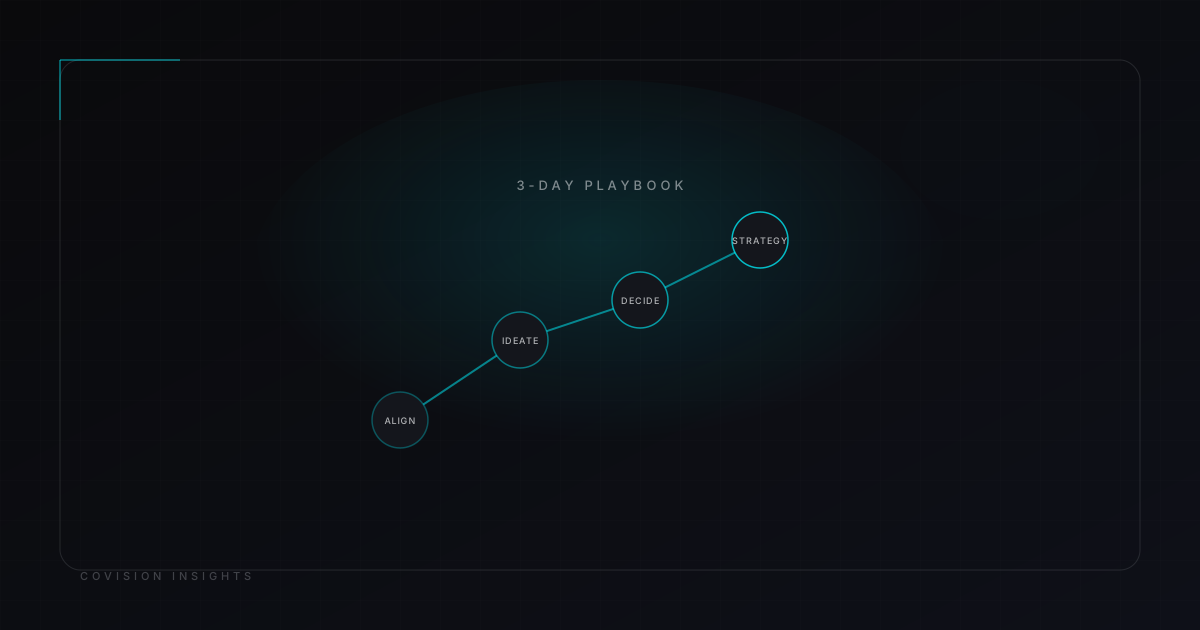
The countermeasure: Make synthesis an in-session activity. This requires tools and session architecture designed to support it. A structured intake system captures ideas in real time. A mid-session clustering exercise organises them before the afternoon. A live output review in the final session block validates the synthesis with participants in the room. The goal is a draft output that is 90% complete before anyone leaves.
Mistake 6: The Three-Week Follow-Up Deck
What it looks like: Even when the facilitation itself is excellent, the output arrives three weeks after the session in the form of a polished slide deck. The deck is thorough. The executives who review it have lived through three weeks of operational reality since the session. The ideas feel dated. The momentum is gone.
Why it kills momentum: Decision-making momentum is time-sensitive in a way that most facilitation practices underestimate. A study of post-workshop implementation rates at Accenture found that initiatives presented to executive decision-makers within 24 hours of a workshop session had a 62% higher implementation rate than those presented three weeks later, controlling for idea quality. The deck is not the problem. The delay is.
The countermeasure: Restructure the follow-up timeline. Same-day executive summary. 48-hour full synthesis document. No polishing at the expense of speed. A structured, accurate document delivered in 24 hours creates more value than a beautifully formatted deck delivered in three weeks. Clients who have experienced same-day output do not want to return to the three-week model.
Mistake 7: No Executive Mandate Before the Session
What it looks like: The workshop is organised by an innovation team or middle management layer. Senior executives are "aware" of it. The session itself is excellent, well-facilitated, genuinely productive, with outputs that reflect serious strategic thinking. The synthesis document arrives. It sits in the executive reading pile behind three more urgent operational issues. Nothing happens.
Why it kills momentum: Without explicit executive mandate, every innovation workshop output must compete with operational reality for executive attention. Operational reality almost always wins, because it has immediate consequences and the workshop output does not.
The countermeasure: Establish executive mandate before the session opens, not after. This means a named executive sponsor who has committed to review and respond to the output within a specific timeframe, has authority to allocate resources or initiate next steps without further committee approval, and was involved in defining the decision mandate that the session is designed to address. Without this, the workshop is a thought exercise. With it, it is a decision-making mechanism.
Closing: Structural Problems Require Structural Solutions
None of these seven mistakes is the result of bad intentions. They are structural failures, predictable consequences of workshop formats that were designed for a different era and have not been updated for the decision-making requirements of modern enterprise organisations.
The countermeasures described above are not theoretical. They are operational choices that require different tools, different session design, and different client conversations. Facilitation practices that have built these countermeasures into their standard methodology, and that use platforms like CoVision to support same-day synthesis and structured intake, consistently outperform those that have not on the only metric that ultimately matters: how often their workshop outputs produce decisions that change something.
The seven mistakes are common. They are also avoidable. The question is whether your next session is designed to avoid them.