The Evaporation Problem
Leadership summits are among the most expensive facilitation investments an organisation can make. Factor in executive opportunity cost, travel and accommodation, venue and production, facilitation fees, and follow-up processing time, and a three-day offsite for 40 senior leaders costs in the range of £150,000 to £400,000 before a single decision is made.
The return on this investment is not measured in engagement scores. It is measured in decisions that change what the organisation does, and in whether those decisions are still active 90 days later.
The evidence on this is uncomfortable. McKinsey research on strategy execution consistently finds that fewer than one in three strategic initiatives identified in leadership sessions result in funded, resourced programmes within 90 days. The primary cause is not poor ideas, it is poor conversion. The ideas generated in the room do not reach a decision state before the momentum dissipates.
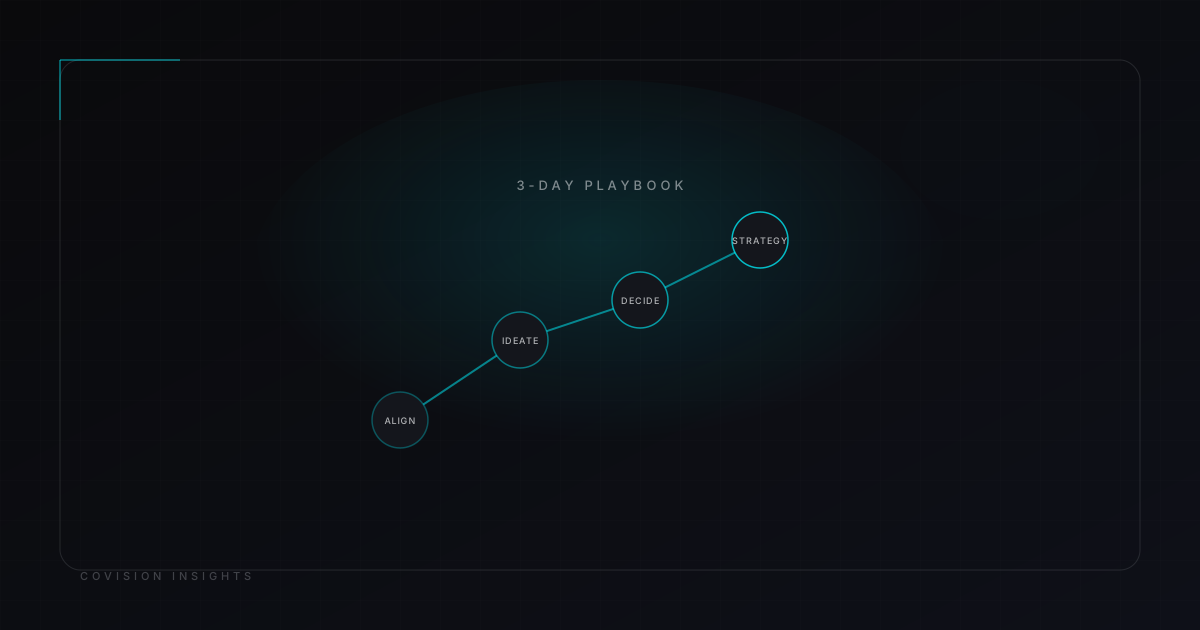
The three-day arc described here is designed specifically for this problem. It structures the summit around a sequence, alignment, ideation, decision, that ensures every day produces a concrete output, and that the final day produces decisions, not summaries.
Day One: Alignment
The most common structural failure of leadership summits is beginning with ideation before establishing shared context. When participants arrive with different mental models of the organisation's strategic position, every ideation session produces work that is implicitly anchored in different realities. The synthesis becomes an exercise in reconciling incompatible assumptions rather than building on shared understanding.
Day One is not an ideas day. It is a calibration day.
Morning: Reality Setting
The morning session presents a structured current-state analysis. This is not a performance for the leadership team, it is a shared calibration exercise. The goal is to ensure that 40 people, many of whom have spent the past year in different parts of the organisation with different information environments, are working from the same factual base.
Content for the reality-setting session:
- Performance against strategic commitments: what was committed to 12 months ago, what was achieved, and what the gap is. This session is most effective when the analysis is not presented by the function that owns each commitment.
- Market context: what has changed in the competitive and regulatory environment since the last summit.
- Capability inventory: where the organisation has built new capability and where gaps have widened.
This session should be factual and brief, no more than 90 minutes of presentation and 30 minutes of structured discussion. Its output is not a document. It is shared context.
Afternoon: Strategic Tension Mapping
Alignment does not mean consensus. It means clarity about where the organisation agrees and where it does not. Day One's afternoon session surfaces strategic tensions, the genuine disagreements about priority, direction, and trade-offs that exist among the leadership team.
A structured tension mapping exercise asks each participant to identify the two or three strategic trade-offs they believe the organisation is most wrong about, or most undecided on. These are collected, aggregated, and displayed as a tension map, a visual representation of where the leadership team's views diverge.
The tension map is not a conflict document. It is a work agenda for Day Two. The concepts and options generated in the ideation day should address the most significant tensions, not the questions the room already agrees on.
Day One output: a shared current-state calibration and a documented tension map that sets the ideation agenda.
Day Two: Ideation
Day Two is the highest-energy day and the most frequently over-designed. Facilitation teams often fill this day with a sequence of ice-breakers, warm-up exercises, lateral thinking techniques, and progressive reveal formats that consume time without proportionally improving output quality.
The principles for an effective ideation day at leadership level are simpler:
- Define the brief tightly: ideas generated in response to a well-defined tension produce more usable outputs than ideas generated in response to an open prompt.
- Work in parallel: groups working simultaneously on the same brief produce more diverse outputs than groups working sequentially.
- Structure the capture: ideas captured in a standardised brief format are evaluable; ideas captured as free-form notes are not.
Morning: Sprint One
The morning session is structured around the top two or three tensions identified on Day One. Groups of five to seven are formed, each working on a single tension. They are given a defined brief template and a 90-minute sprint period.
The brief template is identical for all groups: tension articulation, concept description, target outcome, key assumptions, and resource implications. Every group exits the sprint with populated briefs, not just ideas.
At the end of the sprint, briefs are submitted to a central synthesis layer, either facilitated or platform-assisted, and a structured summary is prepared during a break period.
Afternoon: Review, Red Team, and Sprint Two
The afternoon opens with a facilitator-led review of the morning's outputs. The goal is not to evaluate the concepts at this stage, it is to identify the most significant gaps and the most important tensions that the morning sprint did not address.
A short red team rotation (15 minutes per concept, using the adversarial questioning format) ensures that the strongest concepts have been challenged before the decision day. This is the point at which weak concepts should be identified, not on Day Three, when the energy in the room is committed to action.
Sprint Two addresses either the gaps from Sprint One or a second set of tensions. The process is identical. By the end of Day Two, the summit has a documented portfolio of structured concept briefs, typically 12 to 25 concepts depending on group size and sprint structure.
Day Two output: a structured portfolio of concept briefs, red-teamed and synthesised, ready for decision-day evaluation.
Day Three: Decision
Day Three is the most underdeveloped day in most summit designs. It is frequently structured as a presentation and voting exercise, groups present their concepts, the room votes, and the top concepts are declared winners. This format produces a ranked list, not a decision.
A ranked list is not a decision because it contains no commitment. "Concept A was voted most important" is not the same as "Concept A will be funded to [specific level] by [specific date], owned by [named person], with [defined success criteria] reviewed at [named review cycle]."
Day Three should produce the second type of output for every concept that advances.
Morning: Portfolio Evaluation
The morning session evaluates the Day Two portfolio as a decision set, not as a competition. The evaluation framework is three-dimensional:
- Impact potential: if this concept succeeds, what is the magnitude of the outcome?
- Confidence level: how well-validated are the key assumptions underlying this concept?
- Resource requirement: what is the minimum viable investment to generate a funded decision on this concept within 90 days?
Using these three dimensions, the portfolio is sorted into three categories:
- Immediate action: high impact, sufficient confidence, defined resource requirement
- Structured validation: high impact, insufficient confidence, requires specific validation before funding
- Deprioritise: insufficient impact or insufficient confidence relative to resource requirement
The objective is not to advance every concept, it is to be clear about which concepts the organisation is committing to, and in what form.
Afternoon: Commitment Registry
Every concept in the "immediate action" and "structured validation" categories must exit Day Three with a commitment registry entry:
- Named owner
- Next milestone and date
- Resource allocation (approved or pending, with named approver and timeline)
- Review checkpoint, the next moment at which progress will be formally assessed
The commitment registry is not a summary document. It is a governance artefact. It is distributed to all participants within 24 hours and forms the basis of the 90-day follow-up review.
Day Three output: a commitment registry with named owners, timelines, and review checkpoints for every advanced concept.
The Role of Same-Day Reporting
The 24-hour period after a summit is the highest-value window for follow-up communication. Participants are still engaged, decisions are fresh, and the social commitment made in the room is strongest. Every day that passes before the output document arrives reduces the probability of follow-through.
Same-day reporting, a structured output document distributed on the evening of Day Three, is operationally significant, not just a production nicety. It captures decisions at their moment of highest commitment and creates an immediate accountability record.
Platforms like CoVision enable same-day reporting by producing structured concept briefs in real time during the session. The synthesis that would otherwise take three to five post-session days to produce is available immediately, enabling the commitment registry to be finalised and distributed before participants board their flights home.
The difference between a summit that produces lasting strategy and one that produces a week of energy followed by two weeks of drift is not the quality of the ideas. It is whether the decisions survive the transition from the room to the office. That transition requires documentation, speed, and named accountability, and it must begin before the event ends.