The Offsite That Produces Nothing
The pattern is familiar. Forty senior people spend two days in a conference centre outside the city. Flip chart sheets cover the walls. The energy is high. The presentations are polished. On the final afternoon, the facilitator clusters post-its into themes and everyone nods at the summary slide.
Six weeks later, nothing has changed. No owner. No budget line. No decision recorded.
This is not a failure of effort or intent. It is a structural failure, the offsite was designed for expression, not decision. Fixing it requires rethinking the architecture before anyone arrives.
Pre-Offsite: The Three Conditions for a Productive Session
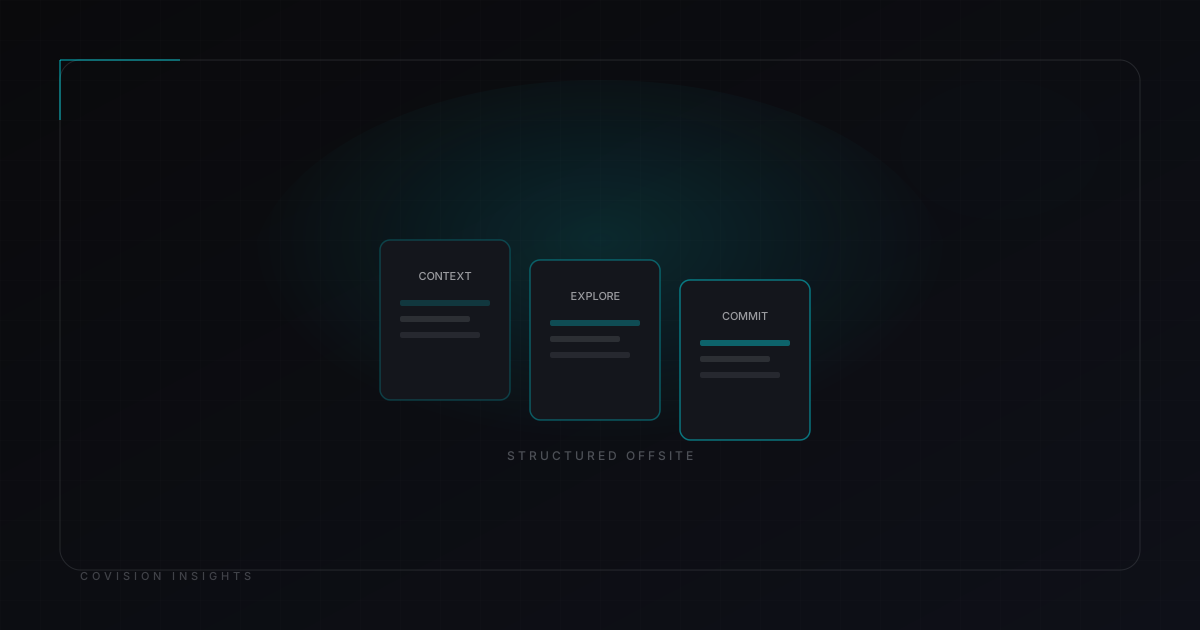
Stakeholder alignment on scope. The single most common source of offsite failure is misaligned expectations about what the session is for. Some attendees arrive expecting to debate strategy. Others expect to rubber-stamp decisions already made. A structured pre-brief, sent no less than ten days in advance, should define the decision scope explicitly: what is in play, what is not, and what level of authority is present in the room.
Brief preparation by participants. Each attendee should arrive with a prepared position on the two or three strategic questions the offsite will address. A one-page brief format, opportunity, evidence, recommendation, risks, forces early thinking and reduces the time wasted on information-sharing during the session itself. Sessions that begin with prepared positions rather than cold prompts consistently produce stronger outputs in less time.
Defined success criteria. Before the event, the organiser and executive sponsor should agree on what a successful offsite looks like in concrete terms. Not "productive conversations" but "three initiatives approved for resourcing, each with an owner and a 90-day milestone." Vague success criteria produce vague outcomes.
During the Offsite: Four Structural Elements
The Morning Alignment Session (90 minutes)
The first ninety minutes should not be used for ideation. They should be used for calibration. The facilitator presents the strategic context, market position, resource constraints, decision authority present in the room, and ensures all participants are operating from the same information set. This is also the moment to surface any blocking disagreements that would derail the afternoon. A disagreement identified at 9am can be resolved. A disagreement surfaced at 4pm derails the day.
Structured Ideation Blocks (2 × 75-minute blocks)
Each ideation block should operate with a constrained brief, a single question with defined parameters. "What should we prioritise in our emerging markets expansion over the next 18 months, given a €5m envelope and our current team capacity?" is a workable brief. "What are our biggest opportunities?" is not.
Within each block, individual generation should precede group discussion. The evidence from decision science is consistent: group discussion before individual generation anchors participants to the first ideas surfaced, reducing the range of options considered. Give people fifteen minutes to develop their own position in writing before any group exchange.
Synthesis Rhythm
After each ideation block, allocate thirty minutes for explicit synthesis. This is not a coffee break with discussion. It is a structured review: which ideas were raised by multiple participants independently (a signal of convergent relevance), which ideas are in tension, and which ideas are genuinely novel relative to current strategy.
The facilitator should produce a one-page synthesis document at the end of each block. These documents become the working material for the decision session.
Decision Protocols
Decisions made at offsites decay unless they are recorded in a format that creates accountability. At minimum, each decision should capture: the recommendation, the evidence base relied upon, the decision-makers present, the owner assigned, the resources committed, and the first review date.
The final ninety minutes of any executive offsite should be reserved exclusively for this process. Facilitators who allow ideation to bleed into the decision window end the day with consensus on principles and no decisions on actions.
Post-Offsite: The 48-Hour Rule
The synthesis document, all decisions, owners, and first milestones, should be distributed within 48 hours of the session closing. After 48 hours, the psychological salience of the offsite begins to fade and competing priorities reassert themselves. Documents distributed later than this window are read less carefully and actioned less reliably.
The 48-hour summary should be a single page. Not a 40-slide deck. Not a narrative report. One page: decisions taken, owner for each, resourcing committed, and first 30-day checkpoint date.
The 30-day checkpoint is not optional. A structured review, even a 45-minute call, at the 30-day mark maintains momentum and surfaces early blockers before they become reasons for abandonment. Programmes that skip this checkpoint have measurably lower implementation rates than those that hold it.
Common Executive Offsite Failure Patterns
The ideas-to-themes trap. Facilitators who cluster ideas into themes at the close of the session create an illusion of synthesis without producing decisions. Themes are descriptions of what was discussed. Decisions are commitments to what will happen. These are not the same thing.
The wrong people in the room. Executive offsites fail when the decision authority present does not match the scope of decisions on the agenda. If budget approval requires a sign-off that is not present in the room, the offsite produces recommendations rather than decisions. Check the authority map before finalising the attendee list.
No pre-read, no position. Sessions that begin without prepared participants waste their first two hours on information transfer and position development. That time is expensive. A well-designed pre-read of no more than six pages, distributed ten days in advance, compresses this phase to forty-five minutes.
Social dynamics overriding analytical quality. In most executive groups, the ideas of senior or charismatic individuals receive more weight than their analytical merit warrants. Structured formats, written generation before spoken discussion, scored evaluation criteria, blind peer review, counteract this systematically without requiring anyone to be called out.
Closing the Gap Between the Room and the Board
The most durable executive offsites produce outputs that can travel. A decision recorded in a format readable by someone who was not in the room, with context, evidence, and clear ownership, has a far higher probability of implementation than a verbal commitment made in a session.
Platforms like CoVision are designed for exactly this gap: converting raw ideas and structured workshop outputs into executive-ready briefs and decision records that maintain fidelity to what was actually agreed. When the synthesis work happens in real time during the session, the 48-hour summary is not a reconstruction effort, it is already done.