Why Speed Matters in Business Model Validation
In a live strategy session, you cannot run a six-week validation study. You need a working hypothesis about whether a concept is worth pursuing before the room empties and the energy dissipates.
The problem is that informal stress-testing is not stress-testing. When participants challenge an idea in open discussion, critique clusters around the most visible weaknesses and skips the structural ones. Confident presenters survive scrutiny. Quiet ones do not. Neither outcome correlates reliably with business quality.
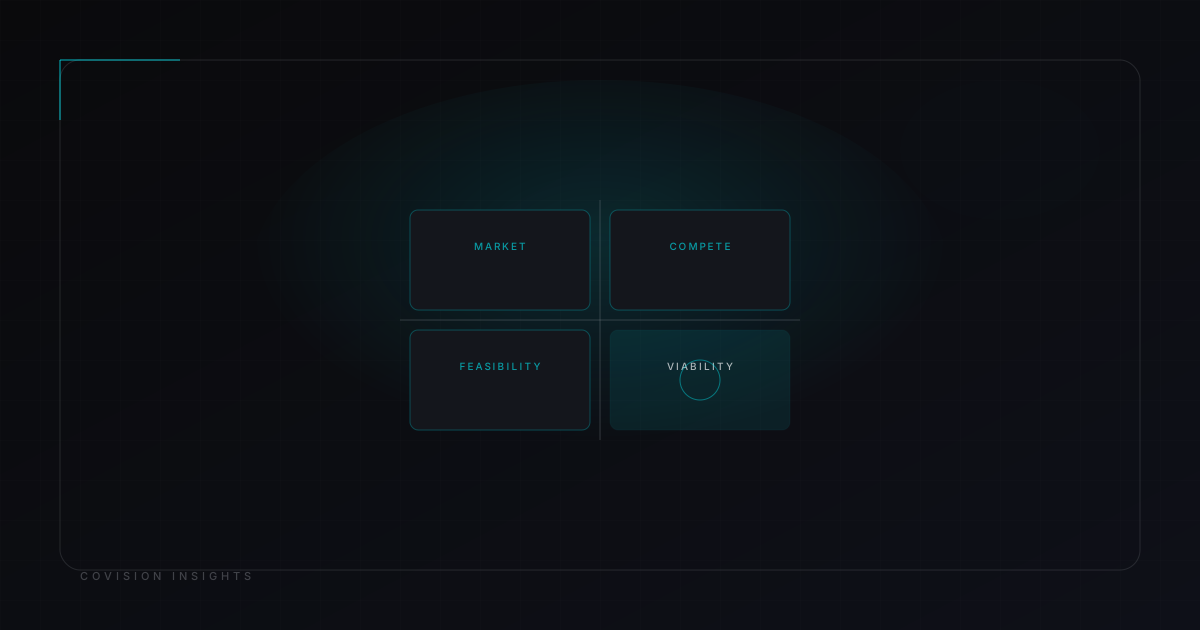
A structured stress-test solves this. It forces every concept through the same five-dimensional filter, regardless of who is presenting or how polished the pitch is. Done properly, a full five-dimension review can run in 45 minutes for a single concept.
This guide gives you the framework, the questions, and a scoring matrix you can use in a working session today.
The Five Dimensions
Dimension 1: Market Size Assumption
The most commonly inflated number in any concept brief is the addressable market. Most teams begin with a top-down TAM figure that looks compelling and work backward. The stress-test runs the opposite direction.
Questions to ask:
- Who is the first customer, not the eventual market, the first paying customer? What is their specific job title, industry, and problem?
- How many organisations of exactly that type exist in the geographic markets you can realistically reach in year one?
- What is a realistic conversion rate given your current relationships and sales capacity?
- Multiply those three numbers. Is the resulting figure enough to justify the investment?
If the answer requires assumptions about "land and expand" or "network effects" before generating sufficient revenue to survive, that is a signal, not a criticism. Mark it explicitly.
Stress score: Rate 1–5. Score 5 if the first-customer market is well-defined and achievable; score 1 if the concept depends on sequential market development before reaching viability.
Dimension 2: Competitive Moat
A defensible position is not a patent or a first-mover claim. It is a structural advantage that compounds over time, network effects, switching costs, proprietary data, or embedded operational dependencies.
Questions to ask:
- If this concept succeeds, what prevents a well-resourced competitor from replicating it in 18 months?
- Is the moat structural (requires significant time or capital to replicate) or executional (requires doing the same thing better)?
- Who has tried this before and failed, and why? Who has tried and succeeded, and what made them different?
- Does this organisation have a specific unfair advantage, a distribution channel, a data asset, a regulatory relationship, that a standalone startup would not?
Stress score: Rate 1–5. Score 5 if there is a structural, organisation-specific moat; score 1 if the concept relies solely on executional speed.
Dimension 3: Unit Economics
You do not need a full financial model. You need enough clarity on unit economics to know whether the business can survive its own growth.
Questions to ask:
- What does it cost to acquire one customer (time, money, or both)?
- What does it cost to serve that customer for one year?
- What does the customer pay in that year?
- What is the payback period?
- What happens to margins at 10× the current volume? Do they improve, hold, or deteriorate?
The goal is not precision, it is exposure. Concepts where no one can answer these questions in a 45-minute session have an upstream problem that financial modelling will not fix.
Stress score: Rate 1–5. Score 5 if rough unit economics are positive and improve at scale; score 1 if the team cannot estimate customer acquisition or service costs.
Dimension 4: Regulatory Exposure
Regulatory risk is frequently underestimated in innovation sessions because it is slow-moving and invisible until it is not. In healthcare, financial services, data, and infrastructure, regulatory exposure can eliminate an entire business model with no technical or commercial failure.
Questions to ask:
- Which regulatory regimes apply to this product or service (data protection, financial services, health, safety, consumer rights)?
- Is the business model legal in every market where you plan to operate?
- Are there pending regulatory changes in the next 24 months that would materially affect the model?
- What is the compliance cost, and at what scale does it become structural?
Stress score: Rate 1–5. Score 5 if regulatory exposure is well-understood and manageable; score 1 if the team is unaware of applicable regulations or if the model depends on a regulatory grey area.
Dimension 5: Operational Dependency
Novel business models often depend on a specific operational capability that does not yet exist inside the organisation. This dependency is the most common source of post-workshop execution failure.
Questions to ask:
- What must the organisation be able to do operationally to deliver this concept at scale?
- Which of those capabilities exist today, and which must be built or acquired?
- What is the critical path? Which missing capability would halt everything else?
- Is the capability build-or-buy, and at what cost?
Stress score: Rate 1–5. Score 5 if the concept can be delivered with current capabilities or a clearly defined, achievable capability build; score 1 if the concept requires multiple simultaneous capability transformations.
The Scoring Matrix
| Dimension | Score (1–5) | Primary Risk Signal |
|---|---|---|
| Market size assumption | , | Addressable market is overestimated |
| Competitive moat | , | No structural differentiation |
| Unit economics | , | Unclear or negative at scale |
| Regulatory exposure | , | Unknown or unmitigated regulatory risk |
| Operational dependency | , | Missing critical capabilities |
| Total | /25 |
Interpretation:
- 20–25: High-confidence concept. Proceed to structured validation.
- 14–19: Conditional concept. Three or more dimensions require active validation before commitment.
- 8–13: Uncertain concept. Significant assumption risk. Return for structural rethinking.
- Below 8: Fragile concept. The concept as currently structured is unlikely to survive implementation.
Running This in a 45-Minute Working Session
The process works best with three to five people who have different functional perspectives. The session is structured, not a debate.
Minutes 0–5: Brief the group on the concept. Present the one-page concept brief. No questions yet.
Minutes 5–25: Work through each dimension independently. Each participant writes their score and their primary risk signal before any discussion. This prevents anchoring on the first vocal opinion.
Minutes 25–35: Share scores dimension by dimension. Where scores diverge by two or more points, that divergence is itself a signal, it indicates an assumption that the group does not agree on. Surface it explicitly.
Minutes 35–42: Agree on the three highest-priority risks. Each risk must be assigned to a named person and a specific validation method (customer interview, regulatory counsel, pilot design, etc.).
Minutes 42–45: Record the composite score and the three risk-owners. This document becomes the validation mandate.
The Role of Structured AI Critique
Running five-dimension analysis manually across many concepts in a workshop setting creates a facilitation bottleneck. A single facilitator can hold one working group, not six simultaneous groups.
Structured AI critique changes this dynamic. When a concept brief is fed into a system that can simultaneously evaluate all five dimensions against a defined scoring rubric, each working group can receive a structured critique in minutes rather than waiting for facilitator rotation.
The AI critique does not replace human judgment on customer empathy, cultural fit, or political feasibility. It accelerates the factual and structural review, surface assumptions, identify missing information, flag regulatory exposure, so that human deliberation focuses where it adds the most value.
Platforms like CoVision embed this analysis directly into the workshop workflow, enabling a facilitator to run parallel concept reviews without degrading the quality of critique for any individual concept.
What This Is Not
A 45-minute stress-test is a triage tool, not a due diligence process. Its purpose is to identify which concepts are worth investing further time in, and to expose the assumptions that must be tested before commitment.
Concepts that score well on this framework still require validation. The framework reduces the false-positive rate, the volume of weak concepts that consume disproportionate follow-up energy, and ensures that validation resources are directed where they matter.
That is the operational value: fewer dead ends, faster cycles, better decisions.