The Military Origin
The term "red team" originates in cold-war military strategy. NATO planners in the 1960s used "Red" as shorthand for Soviet adversaries. A red team was a group assigned to think and act as the enemy, to find weaknesses in plans by exploiting them, not by reviewing them.
The methodology was formalised in US military doctrine in the 1990s following a series of exercises where red teams exposed critical vulnerabilities in plans that had passed conventional review. The finding was consistent: internal review processes are optimised for identifying execution risks, not for imagining capable opposition. A dedicated adversarial function caught what review missed.
Corporate strategy borrowed the concept in the early 2000s. Intel used red teaming to challenge product roadmaps. Amazon embedded devil's-advocate roles into its working-backwards process. The practice spread to management consulting and risk analysis, where it became a standard tool for stress-testing strategic assumptions.
The application to innovation workshops is more recent, and considerably underdeveloped.
Why Innovation Workshops Produce Survivorship Bias
A standard innovation workshop optimises for idea generation. Participants are encouraged to contribute freely, criticism is discouraged to maintain psychological safety, and facilitation techniques like "yes, and" thinking explicitly suppress adversarial responses.
This is appropriate for the divergent phase of ideation. It is a structural problem in the convergent phase, when the workshop must select which ideas to advance.
Without structured critique, selection is driven by:
- Presentation quality: articulate advocates win, regardless of concept quality
- Social dynamics: senior participants' preferred ideas receive less challenge
- Recency bias: ideas presented late in the session are fresher in memory during voting
- Optimism clustering: in high-energy workshop environments, the group collectively overestimates feasibility
The result is survivorship bias in the concept portfolio. The ideas that advance are the ideas that survived an unstructured social process, not a structured evaluative one. The correlation between these two outcomes is lower than most innovation leads realise.
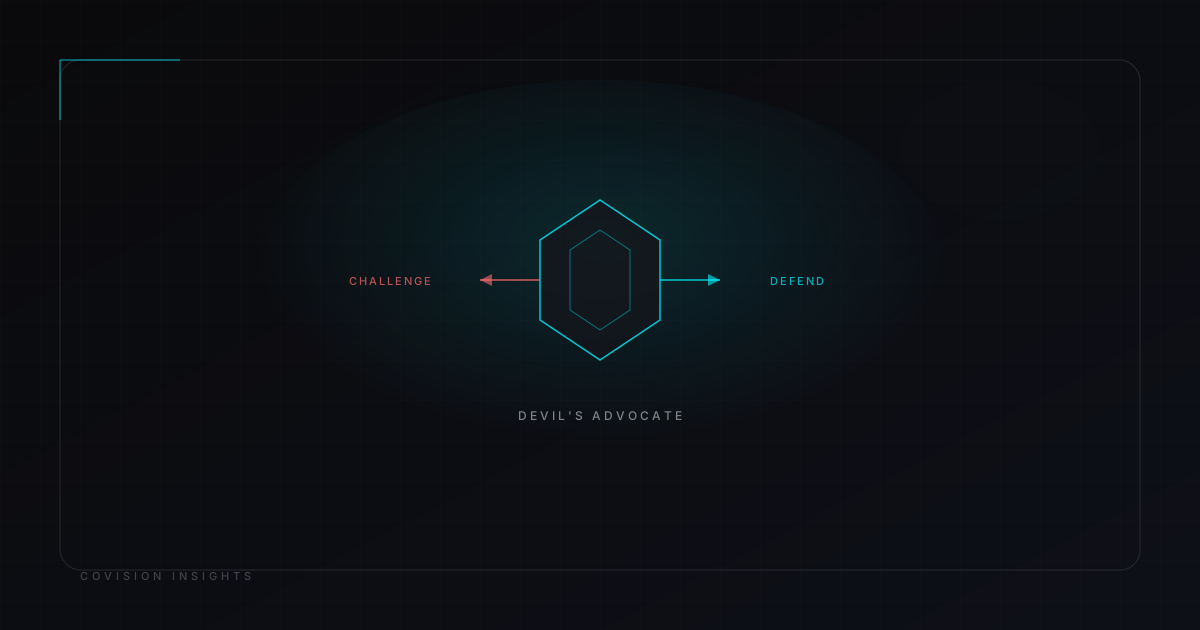
Red team thinking corrects this. By assigning dedicated adversarial function to a subset of participants, or to a structured critique process, it ensures that every concept faces the same quality of challenge, regardless of who presented it or how confidently.
The Four Red Team Questions
Every concept entering the convergent phase of an innovation workshop should be required to answer these four questions. They are designed to be uncomfortable. That is the point.
Question One: What would a well-funded competitor do to kill this in 12 months?
This question forces specificity. "A larger player could enter the market" is not an answer. A red team requires names, mechanisms, and timelines. Which competitor has the distribution, capital, and technical capability to replicate this concept, and what is the realistic timeline for them to do so? If the answer is "any one of three named players within 18 months", the competitive moat claim requires immediate revision.
Question Two: What does the customer do instead if this does not exist?
This question tests the pain hypothesis. If the customer has a viable, acceptable substitute, even an inferior one, the concept's market entry is more difficult than it appears. The question also surfaces whether the problem being solved is actually experienced as a problem by the target customer, or whether it is a problem the innovation team has identified on the customer's behalf.
Question Three: What single assumption, if wrong, kills the entire model?
Every business model has a load-bearing assumption, one belief that, if it fails, causes the entire structure to collapse. Finding that assumption is the most valuable output of a red team review. If the team cannot identify it, the concept has not been analysed with sufficient depth. If the team can identify it but cannot answer how they would know whether the assumption holds, that is the most urgent validation priority.
Question Four: Who in this organisation will actively resist this if it advances?
Internal resistance is systematically underestimated in innovation workshops, because the workshop environment self-selects for supporters. The concepts that die post-workshop most often die not to external market forces but to internal organisational immune responses: territorial conflicts, resourcing competition, cultural friction, or simply the inertia of existing commitments. A red team review that identifies the specific internal stakeholders who would resist, and the specific reasons for their resistance, produces a materially better implementation plan.
The 15-Minute Red Team Rotation
This format is designed for a workshop with five to ten concepts in the convergent phase. It can be run with as few as eight participants.
Setup: Divide participants into concept teams (the advocates) and a rotating red team of two to three people. The red team is assigned, not self-selected, in particular, the most senior participant in the room should be assigned to the red team for at least one rotation, to signal that challenge is structurally required rather than optionally permitted.
Minutes 0–3: The concept team presents their concept in a structured brief format. No open-ended pitching. The brief must include the value hypothesis, the primary assumption, and the intended customer.
Minutes 3–10: Red team works through the four questions, one at a time. Each question gets approximately 90 seconds. The concept team listens and takes notes; they do not respond until the red team has completed all four questions.
Minutes 10–13: Concept team responds to each red team finding. They may update or defend their positions, but every red team challenge must receive an explicit response. "We haven't considered that yet" is an acceptable response; silence is not.
Minutes 13–15: Facilitator records the three most significant risks surfaced and assigns a validation priority to each. The red team rotates to the next concept.
Cycle time: 15 minutes per concept. With two red team groups operating in parallel, a ten-concept portfolio can be fully reviewed in 75 minutes.
The Difference Between Critique and Cynicism
The risk in red team thinking is that it becomes a vehicle for cynicism, a cultural permission to dismiss new ideas without analytical rigour. This is the failure mode that causes innovation teams to resist the process.
The distinction is structural:
Critique is evidence-based and forward-looking. "This assumption is at risk because [specific named competitor] announced a product in this space last quarter" is critique. It gives the concept team something to work with.
Cynicism is assertion-based and dispositional. "Nobody will pay for this" without supporting evidence is cynicism. It terminates thinking rather than advancing it.
Red team protocols prevent cynicism by requiring each challenge to be tied to a specific question and to reference specific evidence or named mechanisms. "Who would kill this and how?" demands a specific answer. "Is this a good idea?" does not.
The facilitator's role is to enforce this distinction actively. Red team challenges that are not evidence-based should be redirected, not suppressed, but sharpened. "What evidence leads you to that conclusion?" is sufficient.
Embedding Red Team Thinking Structurally
The highest-value implementation is to make red team thinking mandatory rather than optional. When it is optional, participants disengage during challenge phases and red team outputs are treated as one input among many rather than as required evidence.
Mandatory red team protocols require every concept to receive structured challenge before entering evaluation. The concept portfolio at the end of the session contains only concepts that have survived adversarial scrutiny, which means the executive sponsor who receives that portfolio can rely on it having been tested, not just selected.
Tools like CoVision embed red team critique directly into the session flow, presenting structured AI-generated challenges against each concept brief as it is produced. This ensures that every concept receives the same quality of adversarial analysis, removes the social dynamics that weaken human-only red team processes, and produces a documented challenge-and-response record that travels with the concept through subsequent review stages.
The goal is a workshop that produces not ideas but tested options, concepts that have been challenged, refined, and documented in a form that can survive the transition from workshop room to boardroom.