The Timing Problem in Market Validation
Traditional market validation is designed for conditions that do not apply to live strategic sessions.
The standard approach, customer interviews, market sizing studies, competitive landscape analysis, regulatory review, produces rigorous outputs. It takes four to eight weeks. By the time results arrive, the strategic context has shifted, the session participants have dispersed, and the concept is competing for attention against whatever has emerged since the workshop.
The timing problem is structural, not a resource question. Even with unlimited budget, a comprehensive market validation programme cannot return results fast enough to inform real-time decisions in a live strategy session.
This creates a gap. Strategy teams working in live sessions make consequential choices, which concepts to advance, which to kill, which to fund for structured validation, on the basis of accumulated intuition and the argument quality of the people in the room. These are weak proxies for market validity.
The four-quadrant validation framework addresses this by structuring what can be assessed rapidly, making explicit what cannot, and identifying where structured validation investment will have the highest return.
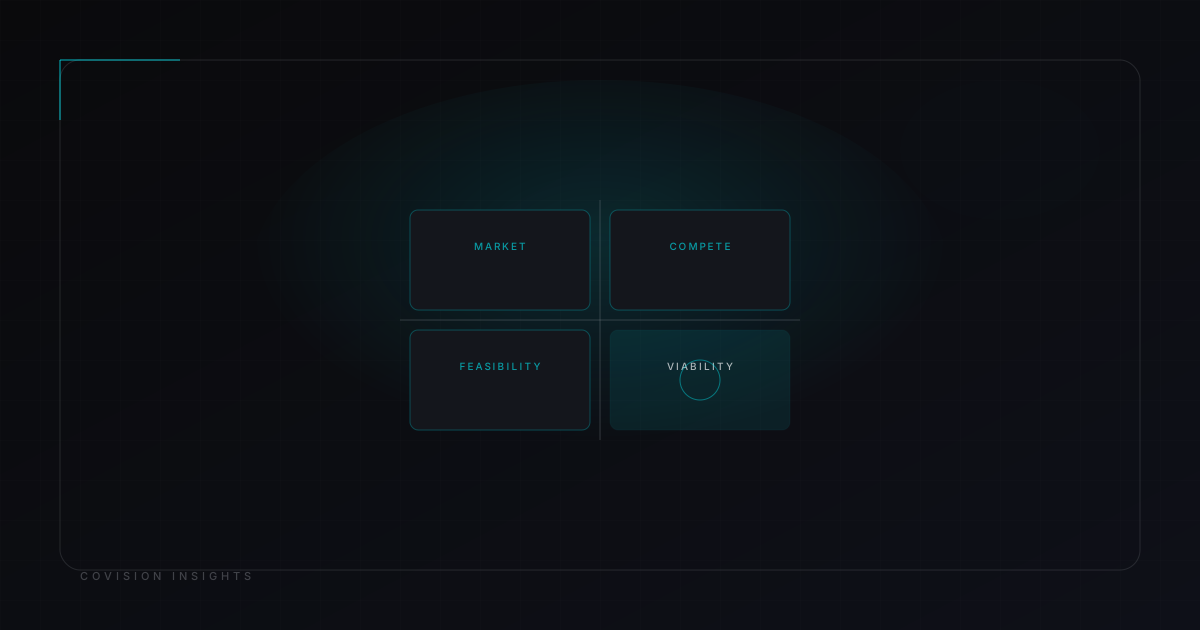
The Four-Quadrant Validation Matrix
The matrix evaluates every concept across four dimensions. Each dimension generates a specific set of analytical questions that can be worked through in a structured session, with or without AI assistance.
Quadrant One: Desirability
Core question: Is there a specific, reachable customer segment for whom this problem is acute enough to motivate a behaviour change?
Desirability is the most frequently overestimated dimension. Innovation teams work with customers for extended periods and develop a conviction that a problem is widely felt. The validation requirement is more specific: not that the problem exists, but that a specific customer segment experiences it acutely enough to take action.
Rapid assessment questions:
- Who is the specific named customer type, job title, industry, company size, who experiences this most acutely?
- What current behaviour demonstrates that the problem is felt? What are they spending time, money, or workarounds on today?
- In a 20-person customer cohort, how many would you expect to describe this as a top-three operational priority?
- What is the closest existing solution, and what specifically does it fail to address?
A desirability score of high-confidence requires named evidence: customer conversations, observed behaviour, or documented complaints. A desirability score of low-confidence, honestly applied, does not kill a concept, it identifies the specific validation activity required.
Quadrant Two: Feasibility
Core question: Can this concept be delivered at the quality, cost, and scale required, by this organisation, in this timeframe?
Feasibility is routinely underestimated when concepts are generated by people who are not responsible for delivering them. The gap between "this is possible in principle" and "we can do this specifically, at this cost, in this window" is where the majority of innovation pilots fail.
Rapid assessment questions:
- What is the minimum viable version of this concept, and what does it require to build?
- Which capabilities already exist inside the organisation, and which must be acquired or built?
- Who would own this? Is there a named team with the mandate and the capacity?
- What is the minimum time to a working prototype, and what is the critical path dependency?
Feasibility analysis in a live session does not produce a delivery plan. It surfaces the top two or three assumptions about capability that, if wrong, make delivery impossible. Those assumptions are the inputs to the follow-up validation plan.
Quadrant Three: Viability
Core question: Is there a business model that generates positive economics at a sustainable scale?
Viability analysis does not require a full financial model. It requires sufficient clarity on unit economics to establish whether the concept is structurally sound.
Rapid assessment questions:
- What does a single customer pay, and over what time period?
- What does it cost to acquire one customer, including time and resource costs?
- What does it cost to serve one customer for one year?
- At what volume of customers does the business reach positive contribution margin?
- Is that volume achievable within the organisation's investment appetite?
The most common viability failure is a concept where the unit economics are superficially positive but where the cost of reaching scale exceeds any plausible investment scenario. Identifying this in a 20-minute session prevents significant downstream waste.
Quadrant Four: Differentiation
Core question: Is there a specific, defensible reason this concept will displace existing alternatives, not just for early adopters, but in a competitive market?
Differentiation is distinct from desirability. A customer can genuinely want a better solution and still not switch, if the switching cost exceeds the value differential. Differentiation analysis must account for both the quality of the advantage and the structural friction that competitors can use to retain customers.
Rapid assessment questions:
- What specifically does this concept do that the best existing alternative does not?
- Is the advantage structural (requires significant time or capital to replicate) or executional (requires doing the same thing better)?
- What does the target customer have to give up to switch to this concept?
- Who currently owns the target customer's budget or workflow, and what leverage do they have to prevent switching?
How AI-Assisted Analysis Runs All Four Quadrants Simultaneously
The traditional validation constraint is serialisation. A research team works through desirability first, then feasibility, then viability, then competitive analysis. Each phase takes weeks. The total timeline is the sum of the phases.
AI-assisted validation runs all four quadrants in parallel, against a defined concept brief. When a structured concept brief, target customer, problem, value hypothesis, revenue model, key assumptions, is submitted to an analysis system, it can simultaneously:
- Identify the customer segment definition gaps and the questions required to confirm desirability
- Map the capability requirements against known organisational constraints and flag missing capabilities
- Run the unit economics against comparable business model analogues to establish viability range
- Generate a competitive landscape summary and identify the specific differentiation risks
The output is not a research report. It is a structured validation mandate, a document that identifies, for each quadrant, the confidence level of the current assessment and the specific activities required to increase confidence.
In a live workshop session, this means every concept can receive a structured four-quadrant validation brief within minutes of being submitted. Facilitation energy focuses on the divergences and the high-risk assumptions rather than on building the analysis from scratch.
What Humans Must Still Own
AI-assisted analysis does not replace human judgment in three areas.
Customer empathy: Understanding whether a customer will actually change their behaviour requires proximity to specific customers. AI analysis can identify which customer type to interview and what to ask. It cannot replicate the insight that comes from a conversation with a sceptical, experienced buyer who has seen a dozen failed versions of the concept being proposed.
Political feasibility: Whether a concept can survive the internal processes of a specific organisation is not assessable from the concept brief alone. It requires knowledge of which stakeholders have authority, which have vested interests in the status quo, and which have the credibility to sponsor unconventional ideas. This knowledge is in the room, not in the analysis system.
Strategic sequencing: Which concepts to advance given a specific organisation's existing commitments, strategic priorities, and resource constraints is a judgment call that requires contextual knowledge that no external system can hold. The validation framework identifies which concepts are strongest in isolation. The strategy team decides which are strongest given the full organisational context.
The Output Format
A concept that has been through the four-quadrant framework exits with a structured validation brief containing:
- Quadrant scores: high confidence / medium confidence / low confidence for each dimension
- Critical assumption: the single assumption that, if wrong, most significantly affects viability
- Validation priority: the one activity that would most increase overall confidence, and the approximate cost and time to complete it
- Go/no-go recommendation: a conditional assessment, if the critical assumption holds, the concept warrants investment; if it does not hold, the concept should be returned for structural revision
This format is directly usable by an executive sponsor or an investment committee. It does not require translation from workshop outputs to decision-ready documentation, it arrives as decision-ready documentation.
Platforms built for this workflow, like CoVision, generate this validation brief automatically from a structured concept submission, enabling a strategy team to exit a live session with a complete, documented portfolio of concept assessments rather than a list of ideas requiring weeks of post-session work.