Why Most Idea Evaluation Fails
In workshops designed to produce innovation, the evaluation phase is typically the weakest element. The ideation phase is energised and generative. The evaluation phase is where good ideas disappear.
Three systematic failures explain most poor evaluation outcomes.
Gut feel dominates. When evaluation criteria are not defined in advance, evaluators default to intuitive judgement. Intuitive judgement in group settings is heavily influenced by presentation quality, familiarity, and the evaluator's own experience domain. An idea that is strategically important but technically unfamiliar to the evaluators is systematically underweighted. An idea that is well-presented but operationally weak is systematically overweighted.
Loudest voice wins. Group evaluation without structure converges on the position of the most senior or most vocal participant. This is not a malicious process, it is the natural result of social influence in unstructured discussion. The outcome is that the evaluation represents one person's view, not the group's analytical assessment.
Recency bias. Ideas presented later in a session are evaluated differently from ideas presented earlier. The later ideas benefit from a warmed-up group with higher engagement; the earlier ideas suffer from lower group familiarity with the evaluation frame. In a ten-idea session, ideas presented in positions 7–10 receive significantly more positive evaluation than ideas in positions 1–3, holding quality constant.
These are not random errors. They are systematic biases that consistently favour certain types of ideas over others, regardless of their actual strategic merit.
The Four-Lens Evaluation Model
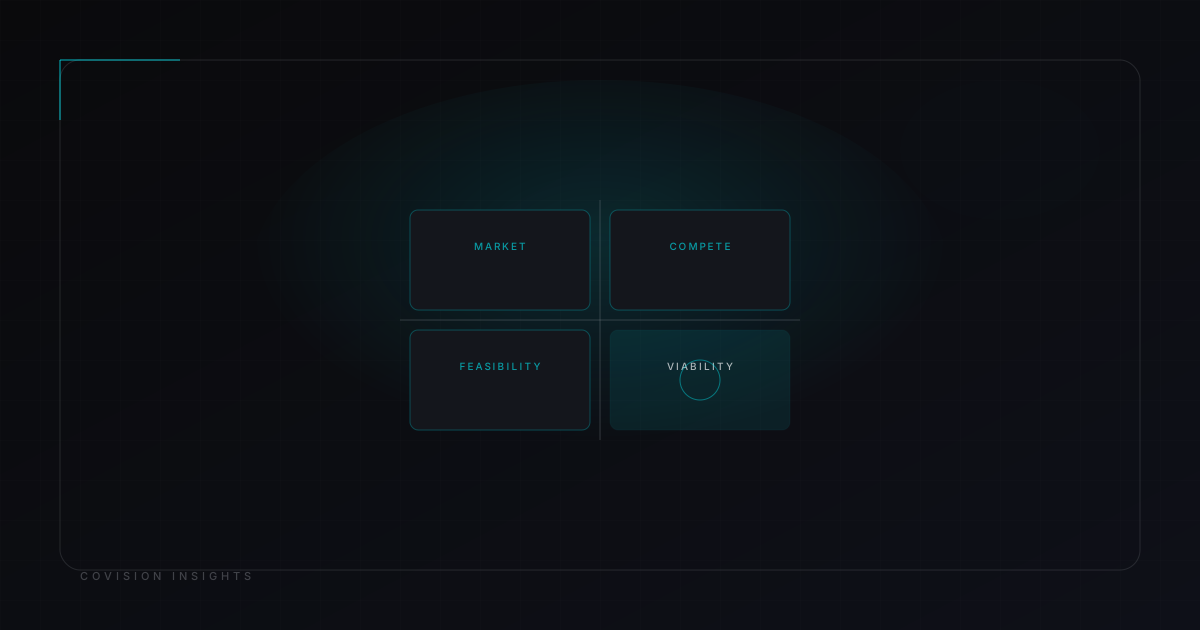
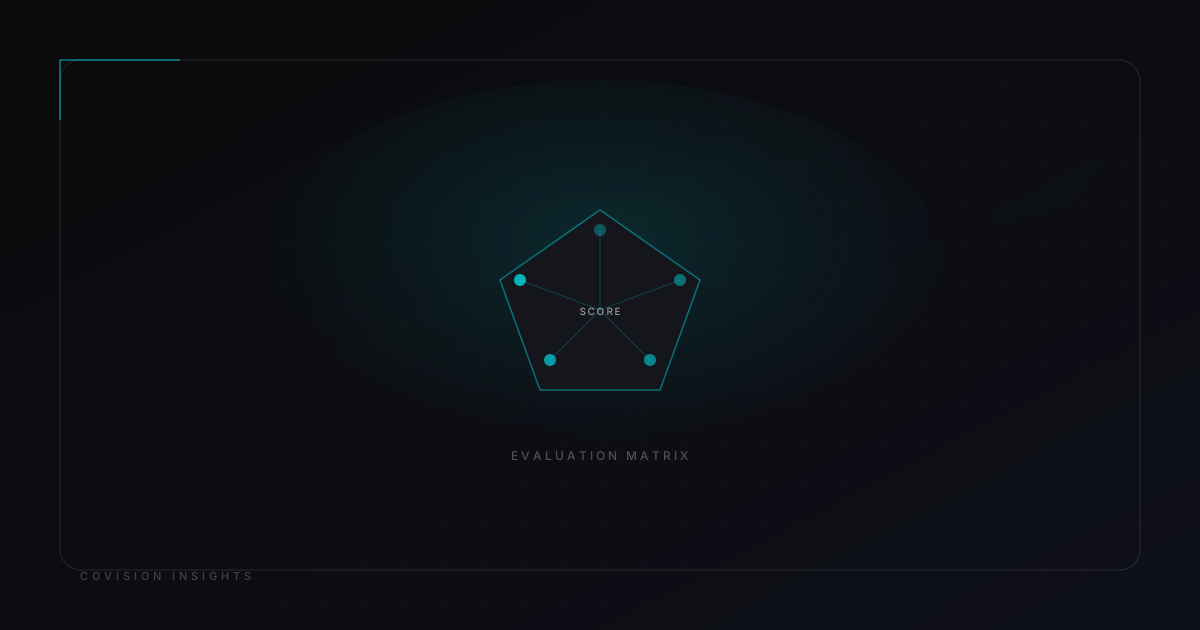
A rigorous evaluation framework applies multiple independent analytical lenses to each idea before any group discussion occurs. The lenses serve distinct functions and are deliberately weighted differently depending on the evaluation context.
Lens 1: Strategic Fit
What it measures: The degree to which the idea addresses a documented strategic priority of the organisation, and whether the organisation has a credible right to pursue it.
How to operationalise it: Score each idea against the organisation's current strategic framework, typically its three to five prioritised initiatives or market positions. An idea that directly addresses a stated priority scores high. An idea that is interesting but disconnected from current strategic direction scores low, regardless of its intrinsic merit.
The "right to pursue" assessment is equally important. An idea may be strategically relevant but require capabilities, market relationships, or regulatory standing that the organisation does not currently possess and cannot credibly acquire within the evaluation window. Including this check prevents the evaluation from generating a list of aspirationally interesting but operationally irrelevant ideas.
Scoring guide: 1–5. A 5 requires explicit alignment with a named strategic priority and confirmation of the organisation's operational capability to pursue it.
Lens 2: Feasibility
What it measures: The technical, operational, and resource feasibility of implementing the idea within a defined time horizon and budget envelope.
How to operationalise it: Three sub-dimensions. Technical feasibility: does the required technology or process capability exist or have a clear development path? Operational feasibility: can the organisation execute this within its current structure, or does it require organisational change that is itself a significant project? Resource feasibility: is the required investment within a plausible budget envelope, or does it require a capital commitment that is unlikely to be approved?
Ideas that score high on strategic fit but low on feasibility are not strong candidates for near-term development. They may be worth tracking for a later cycle when feasibility conditions improve.
Scoring guide: 1–5 across three sub-dimensions, averaged. A 5 requires existing capability, no organisational restructuring, and cost within the current budget framework.
Lens 3: Originality
What it measures: The degree to which the idea represents a departure from the organisation's current approach, competitive position, or market framing.
How to operationalise it: Three reference points. Relative to current strategy: does this idea extend, transform, or contradict current direction? Relative to competitive landscape: is this approach differentiated from what direct competitors are doing? Relative to the session's own idea set: is this a genuinely distinct concept or a variation on an idea that has already been captured?
High originality is not always desirable, a highly original idea may also be highly uncertain. But ideas that score low on originality across all three reference points are unlikely to produce competitive advantage. They represent incremental improvement to the status quo.
Scoring guide: 1–5. A 5 is a concept with no direct competitive analogue that transforms rather than extends the current strategic position.
Lens 4: Risk Profile
What it measures: The nature and magnitude of the principal risks associated with pursuing the idea, and the organisation's current risk capacity.
How to operationalise it: Categorise risks across four dimensions: market risk (does demand exist?), technical risk (can this be built?), regulatory risk (is this permitted?), and execution risk (can this organisation deliver it?). For each risk dimension, assess both probability and reversibility. High-probability risks are more serious than low-probability risks; irreversible failure modes are more serious than recoverable ones.
The risk profile assessment is distinct from the feasibility assessment. Feasibility asks whether the organisation can execute the idea. Risk profile asks what could go wrong if it tries, and how bad "wrong" would be.
Scoring guide: Express as a risk matrix rather than a single score. This preserves the structure of the risk for decision-makers rather than compressing it into a number that discards information.
Running a 10-Minute Evaluation Per Idea
Applied systematically, the four-lens model takes approximately 10 minutes per idea when performed by a trained evaluator. The sequence: review the submission against each lens independently (8 minutes), record scores and notes in the standard evaluation format (2 minutes).
The critical procedural rule: each lens must be assessed before moving to the next one. Evaluators who assess all lenses simultaneously are performing intuitive judgement with a framework label, not independent analytical assessment.
Group vs. Analytical Evaluation Trade-offs
Group evaluation is faster and produces buy-in from participants. Analytical evaluation is more accurate and less susceptible to social influence. The programmes that produce the best outcomes use both, in sequence: analytical evaluation first (to set an evidence-based anchor), followed by group discussion that is constrained to specific dimensions (to surface organisational context that the analytical frame cannot capture).
Group discussion should not be allowed to relitigate the analytical scores without new evidence. The analytical assessment is the baseline. Group discussion can add information; it should not simply overwrite the analysis with consensus.
Building an Evaluation Cadence
For programmes that run recurring sessions, the evaluation framework should be applied consistently across all sessions. This creates a portfolio view: the organisation's idea inventory, scored on the same dimensions over time.
The portfolio view enables three analyses that single-session evaluation cannot support: trend analysis (are the ideas generated in this year's programme stronger than last year's?), coverage analysis (which strategic priorities are consistently generating ideas, and which are consistently underrepresented?), and progression tracking (how are ideas that scored well in early sessions performing in subsequent development cycles?).
Platforms like CoVision are designed to support this evaluation workflow: consistent structured submission formats, built-in analytical assessment at submission time, and a record of scores and synthesis outputs that builds into a searchable portfolio over time. When the evaluation cadence is embedded in the session design, rather than performed manually after every session, the quality of the portfolio compounds with each cycle.