The Sketch Is Not a Rough Draft
In most corporate workshops, the sketch is treated as an intermediate step, a placeholder until the "real" idea can be articulated in words. This is a costly misunderstanding.
The sketch is not a rough draft of an idea. It is a different kind of idea. The cognitive processes engaged when a person draws a concept are meaningfully distinct from those engaged when they write about it. What comes out on paper is not a degraded version of something more coherent; in many cases, it is more coherent, it just doesn't look like it to an audience trained to read text.
Understanding this distinction is one of the most practical things a facilitator can internalise. It changes how you design sessions, how you evaluate submissions, and how much of your participants' thinking you actually capture.
Dual Coding and Why Visual Memory Sticks
The foundational theory here is dual coding, first formalised by psychologist Allan Paivio in the 1970s. The core claim is that the brain processes verbal and non-verbal information through two distinct but interconnected systems. When an idea is encoded in both systems simultaneously, that is, both drawn and described, it is retained more reliably, recalled more accurately, and connected more readily to other ideas.
This has direct implications for workshops. When a participant sketches and labels an idea, they are encoding it twice. When a note-taker transcribes what was said about the idea, only one channel is activated, and typically not the originator's channel.
The practical consequence is that the person who drew the idea on a napkin in the session break often recalls it more vividly three weeks later than the person who wrote it up in the meeting notes. The drawing anchored the memory in a way the text did not.
For facilitators, this suggests a design principle: the sketch is not the input to be transcribed. It is the primary artefact to be preserved.
Spatial Cognition and Strategic Thinking
There is a second, less discussed mechanism at work in visual ideation. Spatial reasoning, the capacity to manipulate objects and relationships in mental space, activates when we draw. Research on spatial cognition consistently shows that people who reason spatially about a problem generate structurally different solutions from those who reason verbally.
The difference is not in quality per se, it is in the nature of the relationships between ideas. Visual thinkers tend to express systems, flows, dependencies, and feedback loops. Verbal thinkers tend to express sequences, arguments, and claims.
For strategic thinking, both are needed. A business model is a system, not a sequence. A market opportunity is a spatial relationship between supply and demand, not a sentence. When you force strategic ideation into a purely verbal format, bullet points, slide frameworks, structured templates, you systematically suppress the spatial reasoning that produces systems-level insight.
This is part of why so many strategy workshops produce lists of plausible recommendations and so few produce genuinely novel structural thinking. The format is not neutral. It shapes what gets thought.
What Sketching Unlocks
Specific cognitive capabilities are more accessible through drawing than through writing:
- Analogical reasoning, drawing something forces you to find a visual analogy, which often reveals structural similarities to other domains
- Temporal mapping, arrows and flows express causality and sequence more naturally than sentences
- Ambiguity tolerance, a rough sketch can hold multiple interpretations simultaneously; a sentence commits to one
- Peripheral capture, the margins of a sketch often contain the most interesting thinking; the margins of a text document are empty
The last point is worth dwelling on. When someone draws a strategic concept, they routinely include elements they did not consciously decide to include. Sketches externalise tacit knowledge, things the person knows but has not yet articulated. A skilled facilitator reading a sketch is reading both the explicit idea and the implicit frame around it.
The Sketch as Commitment Device
There is a behavioural dimension to visual ideation that is often overlooked. When a participant draws an idea, they are making a different kind of commitment than when they type it.
Writing is easily edited. A sentence can be deleted, revised, softened. A sketch is harder to walk back, it is spatially occupying. The act of committing a concept to paper in visual form tends to produce more direct, less hedged expression of what a person actually thinks.
This matters in enterprise settings where organisational politics routinely soften ideas before they surface. In a well-designed sketch-based ideation session, you will often see participants express bolder positions than they would in a discussion or written submission, simply because the format does not invite the kind of iterative qualification that text does.
The sketch captures the initial conviction, before self-editing. That is often the most strategically valuable version of the idea.
Why Visual Outputs Survive the Follow-Up
There is a third practical mechanism worth understanding: visual artefacts circulate differently from text artefacts.
A photograph of a sketch, even a rough one, is more likely to be shared, more likely to be remembered when shared, and more likely to prompt a reaction in the recipient than a block of meeting-note text expressing the same idea. This is not a judgement about quality, it is an observation about how people process and transmit information.
In the context of post-workshop follow-up, this matters enormously. The single biggest challenge in enterprise innovation is the signal loss between session and decision. Ideas that generated genuine energy in the room arrive on an executive's desk three weeks later as decontextualised bullet points. The energy does not travel.
Visual outputs retain more of the original context. The sketch of the idea, especially when rendered with structural clarity and paired with a concise brief, carries with it more of the original intent than a text transcript. Executives who see a well-presented visual concept brief make faster, more confident decisions than those working from text descriptions of the same idea.
Designing for Visual Fidelity
Given all of this, what does a well-designed visual ideation session look like?
Protect the initial sketch. Do not ask participants to redraw, clean up, or explain their sketch before it is captured. The raw first version contains information that a refined version will lose. Capture it as submitted.
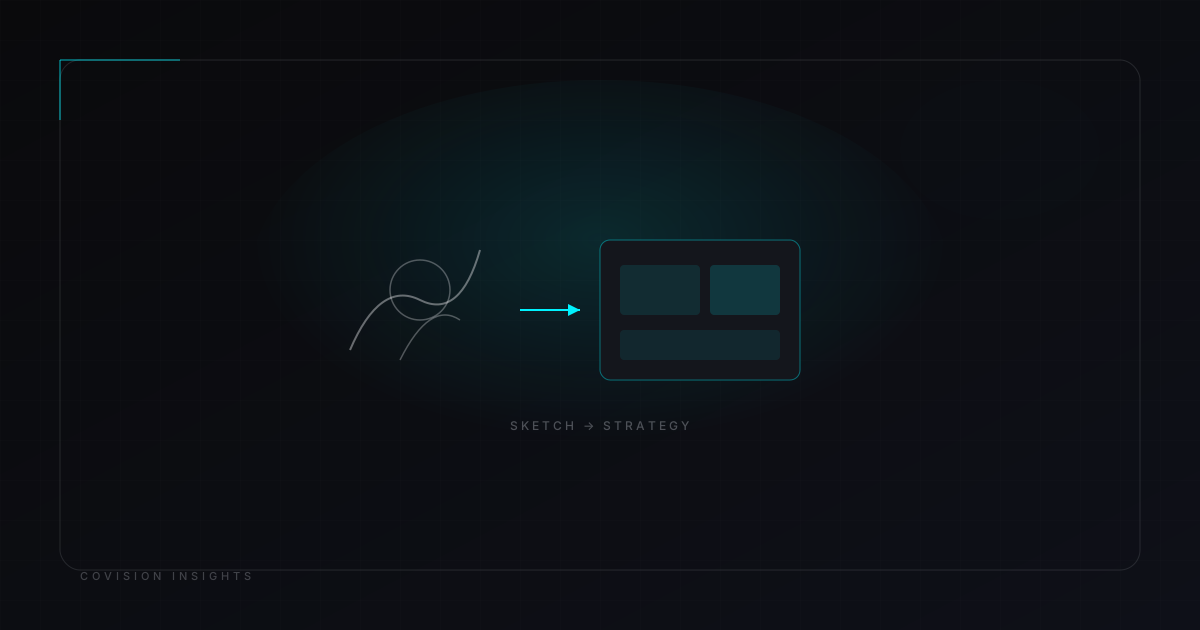
Give the sketch interpretive support, not interpretive replacement. The goal of any synthesis layer, human or automated, is to help the sketch be understood, not to substitute for it. A structured brief derived from a sketch should accompany the visual, not replace it.
Preserve the spatial relationships. If a participant drew an arrow from one element to another, that arrow is a strategic claim. Do not flatten it into prose. Preserve it, or represent it explicitly in the structured output.
Make the sketch visible in the output. Any report or brief derived from a visual ideation session should include the original sketch. Executives reviewing the output are not just reading the analysis, they are reading what the participant actually thought, in the form in which they thought it.
What This Means for Session Output Quality
Platforms and processes that treat the sketch as an input to be discarded after text extraction are systematically degrading the quality of their output. The brief derived from a sketch, without the sketch, is a partial record.
The most effective approach, and the one that produces the highest-quality executive briefing, preserves the visual alongside the structure. The sketch anchors the analysis in the original human intent. The structured brief makes it legible at executive level. Together, they carry more signal than either alone.
For facilitators designing sessions with genuine strategic output ambitions, this means the capture process is not a logistics question. It is a quality question. How the sketch is captured, preserved, and presented determines how much of the participant's actual thinking reaches the decision-makers.
Designing a session where visual thinking is properly captured and structured into executive-ready output is exactly the problem CoVision was built to solve. The sketch is preserved, the structure is generated in real time, and the output carries both.