The Sprint That Shaped a Decade
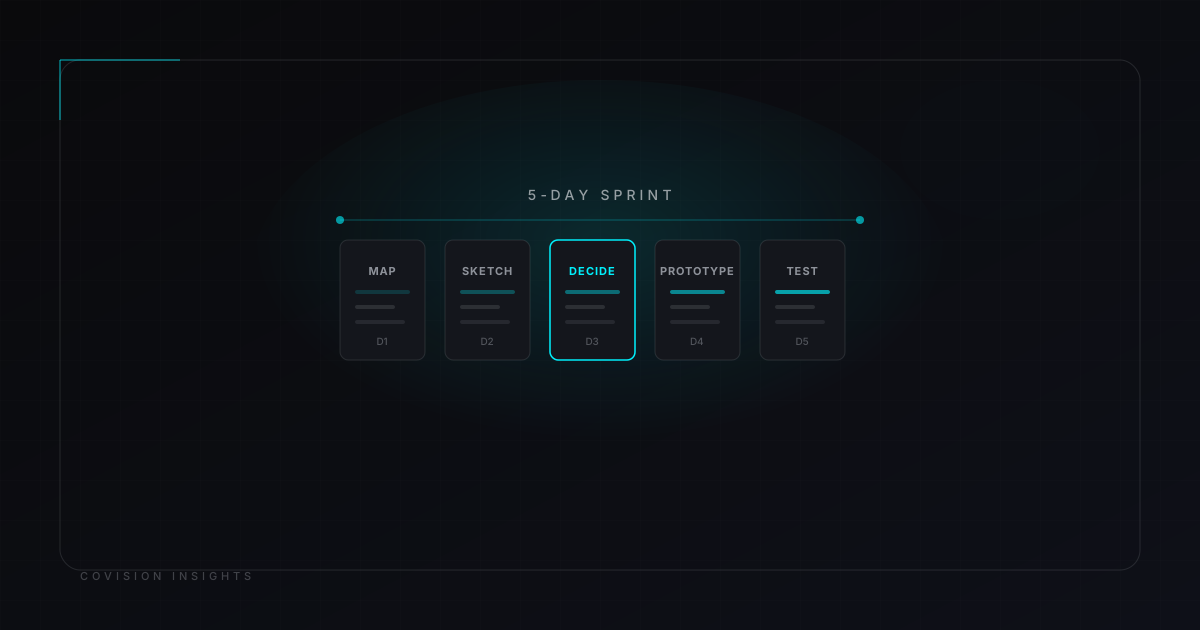
In 2010, Jake Knapp began running structured five-day problem-solving sessions at Google that would eventually become the GV Design Sprint, one of the most influential process frameworks in the history of product development. The methodology's genius was its constraint: five days, a defined sequence, a prototype, and real user testing. It forced decisions that organisations chronically deferred.
By 2016, the Design Sprint had migrated from Silicon Valley to management consultancies, enterprise innovation labs, and corporate accelerator programmes worldwide. It was, for a period, the gold standard for rapid strategic and product alignment.
In 2026, it is showing its age in ways that matter.
What the Original Sprint Got Right
Before examining its limitations, the sprint's durable contributions deserve acknowledgement. The core GV structure established several principles that remain valid:
Time-boxing creates decisions. A five-day hard stop forces participants to work within constraints they would otherwise negotiate away. The decision quality that emerges from genuine time pressure is consistently higher than from open-ended exploration.
Sequential phases prevent simultaneous conflicts. Understanding before ideation, ideation before prototyping, prototyping before testing, this sequencing prevents the common workshop failure mode in which the group simultaneously tries to define the problem and evaluate solutions.
Decider authority matters. The original sprint explicitly required a "Decider", a person with real authority, in the room. This structural requirement forced organisational accountability into the process, preventing the common outcome where workshop outputs return to a committee that wasn't in the room and promptly stall.
These principles hold. The implementation has not kept pace.
Five Ways the Enterprise Context Has Changed Since 2016
1. The Time Economics Have Shifted
In 2016, a five-day full-team sprint was a significant but manageable investment. In 2026, pulling 6–8 senior contributors out of their operational roles for five consecutive days is a genuine constraint for most enterprise teams. Remote and hybrid working norms have made synchronous full-week commitments structurally harder.
The consequence is not that sprints don't happen, it is that they happen with the wrong participants. Teams that can't commit full senior attendance for five days send delegates. Delegates don't have Decider authority. The sprint produces output without the executive mandate needed to act on it.
2. The Prototype-Test Assumption Has Weakened
The original sprint's day 4 prototype and day 5 user test made sense for product decisions where a functional mockup could adequately represent the solution. For the strategic and organisational decisions that most enterprise innovation workshops address in 2026, market entry, portfolio prioritisation, partnership models, operating structure, the prototype-test loop is either impossible or misleading.
You cannot prototype a market entry strategy and test it with five customers on Friday afternoon. Applying the sprint's output mechanism to strategic inputs produces a category error.
3. Synthesis Has Become the Bottleneck, Not Ideation
The original sprint framework was designed for teams that struggled to generate and select ideas. In 2026, most enterprise teams do not lack ideas, they lack structured synthesis. They generate ideas across multiple channels (workshops, off-sites, Slack, quarterly reviews), but they cannot organise, evaluate, and present them in a form that produces executive decisions.
The sprint's five-day structure allocates its time according to a problem, idea scarcity, that is no longer the primary constraint. Synthesis receives little structural attention in the original framework because in 2016 it was a manageable post-session task. In 2026, it is a full process failure point.
4. Participant Expectations Have Elevated
Enterprise teams that have experienced well-facilitated workshops expect certain things that the original sprint framework doesn't provide: immediate access to session output, a structured record of discussion (not just decisions), and clarity on next steps before the session ends. The original sprint's "you'll get the prototype and test results" conclusion doesn't satisfy a senior leadership team that needs a decision brief by Monday.
5. Remote and Distributed Teams Are Now the Norm
The original sprint was designed for co-located teams in a dedicated sprint room. While numerous adaptations for remote teams have been published, none have fully resolved the core tension: the original sprint's value comes substantially from the shared physical context, the visible artefacts, the side conversations, the energy dynamics of a room.
Remote adaptations of the sprint tend to preserve the structure while losing the conditions that made the structure effective.
Five Adaptations for Enterprise Teams in 2026
The answer is not to abandon the sprint framework, it is to adapt it for the context in which enterprise teams actually operate.
Adaptation 1: Compress to One Day, Not Five
For strategic alignment decisions, a well-designed one-day session with in-session synthesis outperforms a five-day sprint that disperses participants and loses momentum. The constraint that made the five-day sprint valuable, forcing decisions through time pressure, is preserved in the one-day format with more senior participation.
This requires front-loading the sprint's understanding phase into pre-session prep: structured briefing documents, pre-work reflection exercises, and context-setting that participants complete before they enter the room.
Adaptation 2: Replace "Prototype and Test" with "Synthesise and Decide"
For strategic inputs, the sprint's output mechanism should shift from prototype-and-test to synthesise-and-decide. The goal of day 5 is not a prototype, it is a structured decision brief that executives can act on. This requires in-session synthesis capability, not a design tool.
The decision brief format should answer four questions for each prioritised idea: what is being proposed, why the group believes it has merit, what is required to move it forward, and who is responsible for the next step.
Adaptation 3: Embed a Decider Protocol at Session Open
The sprint's Decider requirement remains one of its most important, and most frequently violated, structural elements. Enterprises running sprint-format sessions should establish a formal Decider protocol at session open: a named individual with explicit mandate to commit organisational resources, whose decisions during and immediately after the session are binding pending formal sign-off.
Without this, the synthesis output lands in a decision vacuum. The ideas may be excellent. They still don't move.
Adaptation 4: Build Live Synthesis Into the Session Architecture
Rather than treating synthesis as a post-session task, modern sprint adaptations should incorporate structured in-session synthesis as a first-class activity. This means using platforms and tools capable of organising and surfacing participant contributions in real time, so that by the afternoon session, the group is working with a structured view of the morning's output, not a wall of sticky notes.
Adaptation 5: Distribute Output Before the Room Empties
One of the most impactful structural changes available to enterprise sprint facilitators is immediate output distribution. When participants receive a structured session summary, validated by the group, before they leave the building, the follow-up dynamic changes entirely. There is no three-week synthesis gap. There is no degraded context. The decision brief is in the executive's inbox while the session is still fresh.
What Modern Enterprise Teams Actually Need
The design sprint's core insight, that structured time constraints produce better decisions, remains correct. What has changed is the environment in which that insight needs to operate.
Modern enterprise teams need sprint-format sessions that compress to one day, work for strategic (not just product) decisions, produce immediate decision-ready output, and function effectively for senior participants who cannot commit five-day blocks.
Tools like CoVision have been built around these requirements, session architecture designed for strategic alignment, with structured capture and same-day synthesis built into the process. The sprint methodology has evolved. The infrastructure supporting it needs to follow.
The five-day sprint was the right answer for 2016. The question for 2026 is whether your facilitation approach has updated along with the context it is meant to serve.