The Ritual Nobody Audits
At the end of almost every major innovation or strategy workshop, a scene plays out with near-universal consistency. Someone, usually the most junior person in the facilitation team, is tasked with photographing every sticky note wall, transcribing the content into a spreadsheet, and passing that spreadsheet to the consultant who will turn it into a deck. The photos sit in a shared drive. The spreadsheet gets updated a few times. The deck takes two weeks.
This ritual is so embedded in the facilitation industry that it is rarely examined. It should be.
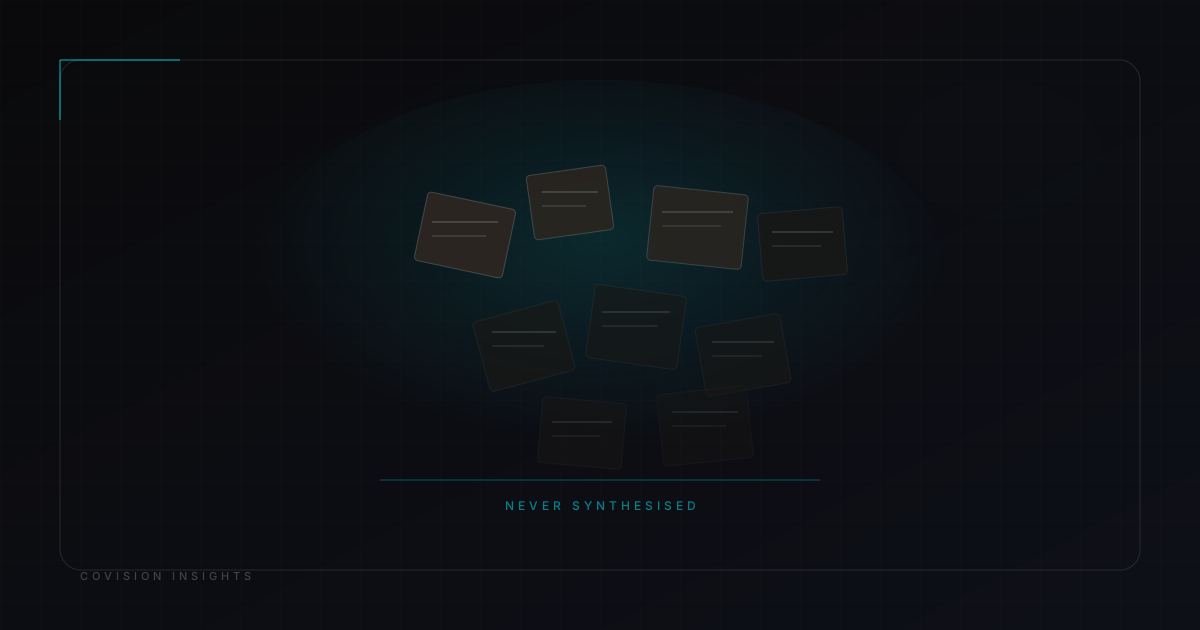
The sticky note wall is not just an aesthetic artefact of an analogue era. It is the primary data loss event in the modern innovation workshop, the moment at which context, nuance, and strategic signal are systematically destroyed and replaced with a sanitised reconstruction.
The Graveyard in Numbers
The "post-it note graveyard" is not a metaphor for disorganisation. It is a precise description of what happens to ideas that enter the analogue capture process. Most do not survive it intact.
Research from Deloitte's 2023 Innovation Benchmarking Study found that of the ideas generated in a typical corporate innovation workshop, fewer than 15% appear in any form in the final synthesis document presented to senior leadership. Of those, fewer than a third are represented with sufficient fidelity for decision-makers to evaluate them properly.
That is an idea mortality rate of over 85% between generation and executive review.
The causes are structural:
- Transcription loss: Sticky notes capture keywords, not reasoning. The explanation a participant gave while placing the note, the context that made the room take it seriously, is lost the moment the session ends.
- Curation bias: The consultant synthesising the output inevitably selects for ideas that fit a coherent narrative, ideas they understand, and ideas that are easiest to present. Unusual or complex ideas are disproportionately filtered out.
- Recency weighting: Ideas generated in the afternoon session, when participants were fresher in the facilitator's memory, tend to receive more airtime in the output than morning ideas.
- Political sensitivity: Ideas that generated visible conflict in the room are often softened or omitted in the written synthesis to avoid presenting the organisation's internal disagreements to leadership.
None of this is intentional. All of it is inevitable in an analogue capture process.
Calculating the Real Cost: A Framework
The full cost of analogue workshop facilitation has four components. Most organisations account for only the first.
Component 1: Direct Synthesis Labour
This is the most visible cost. A full-day workshop for 20 participants typically produces:
- 150–300 individual sticky notes
- 5–8 whiteboard diagrams
- 2–4 hours of recorded or manually noted discussion
- Multiple rounds of small-group output
Converting this into a structured synthesis document requires, conservatively, 10–16 hours of senior consultant time. At a blended rate of £200/hour for a UK-based strategy consultancy, that is £2,000–£3,200 per session in synthesis labour alone, before any other post-session work.
For an organisation running eight major workshops per year, the annual synthesis labour cost sits between £16,000 and £25,600, spent producing documents that could have been generated in the session itself.
Component 2: Decision Delay Cost
Every week between a workshop and executive review is a week in which the ideas are not being acted on. For strategic decisions with material business impact, a new product line, a market entry, an organisational restructure, the cost of a three-week delay can dwarf the facilitation fee entirely.
A reasonable proxy: if the decision being workshopped has a potential £1M annual revenue impact, and a three-week delay reduces implementation confidence by 20% (accounting for the momentum decay described in the research), the expected value of that delay is £200,000 in foregone opportunity. This is not theoretical, it is the compound effect of delayed starts, reduced buy-in, and lower implementation fidelity.
Component 3: Rework and Clarification
Synthesis documents produced from analogue capture almost always require clarification rounds. Participants dispute how their contributions were represented. Executives ask for more detail on specific points. The facilitator must return to notes and photos to reconstruct context that should have been captured in the first place.
Industry benchmarks suggest that 25–40% of post-session consultant time is spent in clarification and rework cycles, effort that would be eliminated by accurate, context-rich in-session capture.
Component 4: Idea Mortality Opportunity Cost
This is the hardest to calculate and the most important. It is the value of the ideas that died in the graveyard, ideas that had sufficient merit to be generated by experienced participants in a structured session, but insufficient infrastructure to survive the synthesis process.
There is no clean formula for this. But a useful proxy: if a workshop produces 200 discrete ideas and 85% are lost or degraded by the time leadership reviews the output, the facilitator is delivering roughly 30 ideas worth of value from a 200-idea investment. The 170 lost ideas represent the delta between what was possible and what was actually delivered.
The Full-Cost Calculation
| Cost Component | Example Organisation (8 workshops/year) |
|---|---|
| Direct synthesis labour | £20,000–£26,000 |
| Decision delay (conservative) | £50,000–£200,000 |
| Rework and clarification | £8,000–£15,000 |
| Idea mortality (proxied) | Unquantified but material |
| Total visible cost | £78,000–£241,000 |
Against these numbers, the additional investment in facilitation infrastructure that eliminates analogue capture is not a luxury, it is a straightforward cost reduction.
What Doesn't Work: Common Workarounds
The facilitation industry has developed several workarounds for the analogue capture problem. They are worth examining honestly.
Photo-to-text apps: Tools that scan sticky notes and convert handwriting to text solve the transcription problem but not the context problem. You now have 200 accurate keywords instead of 200 photos of keywords. The reasoning is still missing.
Dedicated note-takers: Assigning a team member to capture discussion in real time helps preserve context but creates a bottleneck. A single note-taker cannot capture everything, introduces their own selection bias, and produces output in a format that still requires significant post-processing.
Shared digital whiteboards during the session: These preserve the artefact more accurately but shift the synthesis problem rather than solving it. The digital whiteboard still requires a human to review, organise, and convert its contents into a decision-ready document.
Longer synthesis timelines: Some consultancies have responded by setting explicit expectations, "you'll receive the synthesis document within five working days." This manages client expectations but does nothing to address the momentum decay problem. It simply makes the decay predictable.
The Architecture of Idea Survival
The alternative to the graveyard is not more rigorous analogue capture. It is a fundamentally different session architecture that treats synthesis as an in-session activity rather than a post-session one.
This means capturing ideas against a structured schema as they are generated, enriching them with context during the discussion, and producing a decision-ready output before participants leave the building. The technology to do this exists. The session design discipline to use it effectively is what most facilitation practices have yet to build.
Platforms like CoVision are designed around this architecture, they make in-session synthesis the default, not the exception. The output isn't a reconstruction of what happened in the room. It is what happened in the room, structured for executive review.
The post-it note graveyard is not inevitable. It is a design choice, one that most organisations are making by default rather than intention. The cost of that choice, properly calculated, is rarely what stakeholders assume.