The Physics of Scale
Facilitation methods designed for groups of 12 do not scale to groups of 100. This is not a competency problem, it is a structural one.
When group size increases, three fundamental constraints emerge:
Attention allocation: In a group of 12, a facilitator can monitor every participant's engagement level and adjust dynamically. In a group of 100, attention monitoring is impossible at the individual level. Participants who disengage are invisible until their absence from outputs is counted.
Contribution noise: In open-format sessions, vocal participants dominate. In a group of 12, two dominant voices represent 17% of the room. In a group of 100, two dominant voices represent 2%, but they consume proportionally far more than 2% of the group's attention and shape the perceived consensus disproportionately.
Synthesis bottlenecks: When ideas are generated by 100 people simultaneously, the facilitation infrastructure must either process a vast volume of inputs in real time or defer synthesis to a post-session phase where most of the energy has dissipated. Neither option, managed manually, produces adequate output quality.
Understanding these constraints is the precondition for designing sessions that work. The failure modes of large-group facilitation, sessions that feel active but produce thin outputs, sessions dominated by a small number of voices, sessions where the synthesis takes three weeks and arrives when no one cares anymore, all stem from applying small-group methods at scale.
Traditional Approaches That Fail at Scale
Round-Robin Reporting
Round-robin formats ask each subgroup to present a summary of their work to the full room. In a group of 12 split into three groups of four, this takes about 15 minutes and produces adequate coverage. In a group of 100 split into 20 groups of five, round-robin reporting would require 100 minutes to give each group three minutes, during which 95% of participants are passive audiences.
Even shortened round-robins at scale are counterproductive. The groups presenting last are aware that attention has degraded. The facilitator is aware that time is running out. The outputs become abbreviated, comparison between groups is difficult, and participants from groups that did not present feel their work was discarded.
Open Discussion Voting
Asking 100 people to vote in open discussion on a set of concepts produces a result driven by who speaks first and most confidently. Dot voting or show-of-hands formats reduce this slightly but still advantage ideas that were verbally advocated over ideas that were quietly generated.
At scale, any format that requires verbal participation to signal preference systematically underweights quieter participants, junior participants, and participants from cultures where public assertion is less normative.
Small Group Reporting Synthesis
Some facilitation methods ask each small group to appoint a rapporteur who contributes to a facilitator-led synthesis. At 100 participants with 20 groups, this requires 20 rapporteurs contributing to a single synthesis thread. The cognitive and logistical complexity is unmanageable in a live session. What typically happens is that three or four groups contribute substantively and the rest are aggregated into a generic summary.
Three Architectural Principles for 100+ Person Sessions
Principle One: Parallel Submission
Every participant should be able to contribute simultaneously, through a medium that captures their input for structured review. This means moving away from sequential or round-robin contribution formats and toward parallel digital submission.
Parallel submission solves the noise problem. When all 100 participants are submitting ideas, analyses, or responses simultaneously, no individual voice shapes the perceived consensus. The ideas that emerge are genuinely representative of the room's thinking rather than the first-mover's framing.
The practical requirement is a submission interface that is simple enough to use without facilitation, structured enough to produce evaluable outputs, and reliable enough to work in a room of 100 people simultaneously. This is a technology constraint that shapes the session design: platforms that require complex inputs or significant setup time cannot be used for parallel submission at scale.
Principle Two: Real-Time Synthesis
The value of large-group ideation is in the aggregate. One hundred people can generate more diverse perspectives, surface more non-obvious connections, and identify more gaps in a given strategy space than any individual or small group can. But this value is only accessible if the outputs are synthesised quickly enough to inform the session while it is still running.
Real-time synthesis requires either sufficient facilitation staff (typically one skilled synthesiser per 15 to 20 participants) or structured tools that can cluster, rank, and summarise inputs at machine speed. Most organisations cannot staff for the former. The latter requires investment in session infrastructure.
The operational consequence of failing this principle is significant: sessions where synthesis happens post-session produce outputs that arrive after the energy of the session has dissipated. Decisions that could have been made in the room are deferred. Participants disengage from follow-up communication. The participation cost (time, travel, opportunity cost for 100 senior people) is not recovered in decisions made.
Principle Three: Structured Display
In a large-group session, what is visible to the full room shapes the collective attention. If the only thing displayed on the main screen is a facilitator's notes or a slide deck, participants anchor to the facilitator's framing. If structured outputs, real-time synthesis, aggregated scores, emerging patterns, are displayed continuously, the room engages with its own collective intelligence rather than waiting for an authority to interpret it.
Structured display at scale means designing the room's information environment intentionally: what is shown when, at what level of detail, and with what framing. This is a production design problem as much as a facilitation problem.
Formats That Work at Scale
Parallel Sprint Structure
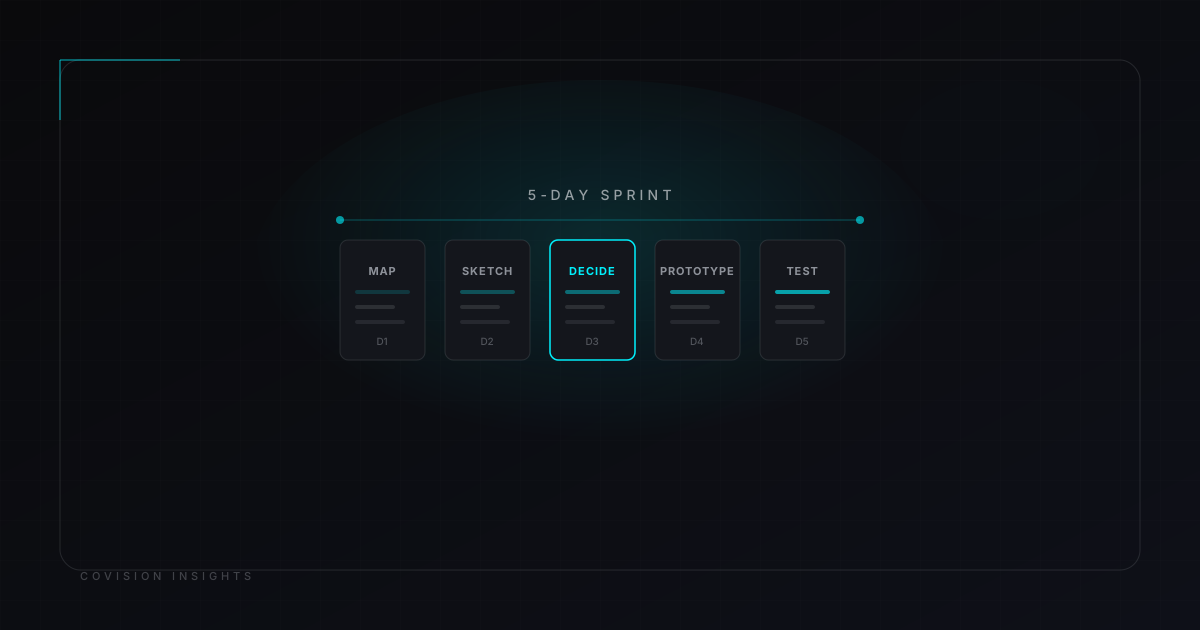
The room is divided into working groups of five to seven. All groups work on the same brief simultaneously, using identical structured tools. After a defined sprint period (typically 20 to 25 minutes), outputs from all groups are submitted to a central synthesis layer. The facilitator presents a structured synthesis to the full room, then opens a second sprint phase where groups respond to the synthesis by deepening, challenging, or extending the most significant findings.
This format produces complete parallel input from all groups, a real-time synthesis that uses every submission, and a second-phase deepening that is anchored in the aggregate rather than in any individual group's work.
Gallery Walk with Structured Scoring
All groups produce a structured output artefact, a concept brief, a prioritised analysis, a risk map, which is displayed simultaneously. Participants rotate through the displayed outputs in a gallery walk format, scoring each against a defined rubric. The scoring is captured digitally, aggregated in real time, and used to rank concepts for a plenary discussion.
This format solves the round-robin problem by making all outputs simultaneously available and by using structured scoring rather than advocacy to surface the strongest concepts.
Fishbowl with Rotating Panels
A fishbowl format places a small discussion group (five to seven people) in the centre of the room, visible to all other participants, while the outer room engages through digital submission, contributing questions, building on arguments, or flagging disagreements. A facilitated rotation brings different voices into the fishbowl over multiple cycles.
At scale, the fishbowl format manages the attention problem by making a small group's deliberation the focal point while giving all participants a structured contribution channel that does not require entering the fishbowl.
Technology Requirements at Scale
Running a 100+ person session with parallel submission, real-time synthesis, and structured display requires technology infrastructure that most organisations underestimate:
- Submission capacity: the platform must handle simultaneous inputs from all participants without latency
- Real-time aggregation: synthesis must be computable from raw inputs within the session timeframe
- Display integration: outputs must be pushable to a room display without manual formatting steps
- Structured input format: submissions must arrive in a structured format, not as free text requiring manual categorisation
Platforms like CoVision are built for exactly this workflow, enabling simultaneous structured submission from all participants, generating real-time concept briefs and synthesis, and producing display-ready outputs that can be projected to the full room without a post-session processing step.
The facilitation goal remains the same whether the room has 12 people or 200: every participant's contribution should reach the synthesis layer, and the synthesis should reach the room in time to shape decisions. The architecture required to achieve this goal is simply different at scale.