Before You Start: What "AI-Driven" Actually Means
The phrase "AI-driven workshop" has been applied to everything from using a shared notes document to sophisticated real-time synthesis platforms. For the purposes of this playbook, the definition is precise: an AI-driven strategic alignment workshop is one in which intelligent processing assists with capture, organisation, and synthesis during the session itself, not after it.
The facilitator's role does not diminish. It changes. The facilitator moves from post-session processing toward in-session direction, spending more time shaping the quality of participant contribution and less time managing the mechanics of capture.
This playbook covers a full-day alignment session for 12–20 participants with a strategic decision mandate. Adapt timing and group structures for half-day formats.
Phase 1: Pre-Session Setup
Duration: 2–3 days before the session
The most common mistake in workshop design is treating setup as logistics. It is not. Pre-session setup is where the decision quality of the entire session is determined.
Define the Decision Mandate
Every strategic alignment workshop should have a specific decision mandate: a concrete question or set of questions that the session is designed to resolve. "Explore innovation opportunities" is not a decision mandate. "Identify the three highest-potential growth initiatives for the next 18 months and rank them against strategic fit, resource requirements, and market timing" is.
The more specific the mandate, the more useful the output. Facilitators who resist specificity at this stage almost always struggle with directionless synthesis later.
Distribute a Structured Pre-Work Brief
Participants should arrive having thought, not just having been told. Send a pre-work brief no later than 48 hours before the session that includes:
- The decision mandate (clearly stated)
- Two or three framing questions to reflect on
- Any relevant context documents (market data, strategic priorities, recent customer research)
- An explicit invitation to bring one idea they believe the group hasn't considered
Pre-work briefs that require genuine engagement, not just reading, increase the quality of first contributions by a measurable margin. A five-minute reflection exercise produces better in-session input than a 20-page briefing document.
Configure the Session Environment
If you are using a structured synthesis platform, configure it before the session opens:
- Set the event brief and session parameters
- Confirm the idea submission schema (problem statement, approach, expected outcome, risks)
- Test the projection setup, participants should be able to see the live state of the session
- Brief any co-facilitators on the capture protocol
Phase 2: Session Opening and Context Alignment
Duration: 30 minutes
Opening (10 minutes)
Begin with the decision mandate, stated explicitly and without softening. Participants need to understand that this session has a specific output requirement and that their contributions are being captured for executive review. This is not a creative free-for-all. It is a structured process with a business outcome.
Briefly explain how the session works: ideas are submitted in structured form, they are synthesised in real time, and the group will see the output being built throughout the day.
Context Alignment (20 minutes)
Before ideation begins, run a 20-minute context alignment. This is a facilitated discussion, not a presentation, in which the group surfaces their shared understanding of the strategic landscape. Key questions:
- What do we agree on about the current situation?
- Where are the points of genuine disagreement?
- What assumptions are we making that should be tested?
Context alignment serves two purposes. First, it levels the room, senior participants' framing assumptions become visible and can be challenged before they dominate the ideation phase. Second, it surfaces the disagreements that the session needs to resolve, so they can be addressed explicitly rather than worked around.
Phase 3: Structured Idea Intake
Duration: 90 minutes
This is the core ideation phase, and its success depends almost entirely on how ideas are captured.
Individual Generation (25 minutes)
Participants work independently to develop their ideas against the structured submission schema:
- Problem or opportunity: What specific gap or possibility are you addressing?
- Proposed approach: What would you do, at a high level?
- Expected outcome: What does success look like in 12–18 months?
- Key risks or dependencies: What could prevent this from working?
Working individually before sharing prevents anchoring, the well-documented cognitive bias in which early vocal participants disproportionately shape subsequent contributions. Independent generation produces more diverse input.
Structured Submission (20 minutes)
Participants submit their ideas through the structured intake system. Each submission is captured against the schema, tagged with the participant's name (optional), and immediately visible to the facilitation team. If you are using a platform with real-time synthesis, the system begins organising submissions as they arrive.
Group Sharing, Round 1 (45 minutes)
Each participant briefly presents their idea, two minutes maximum. The facilitator's job here is not to evaluate but to clarify: ask questions that surface the reasoning behind each idea, not the idea itself. "What made you think about this specifically?" produces better subsequent discussion than "Does anyone have thoughts on this idea?"
As ideas are presented, the synthesis view should be visible on screen so participants can see how their contributions are being captured and organised.
Phase 4: Live Synthesis and Clustering
Duration: 60 minutes
Facilitated Clustering (30 minutes)
With all first-round ideas submitted, the group works together to identify patterns and connections. Which ideas address the same underlying opportunity? Which ideas are mutually dependent? Where do ideas conflict, not in their content, but in their implied strategic priorities?
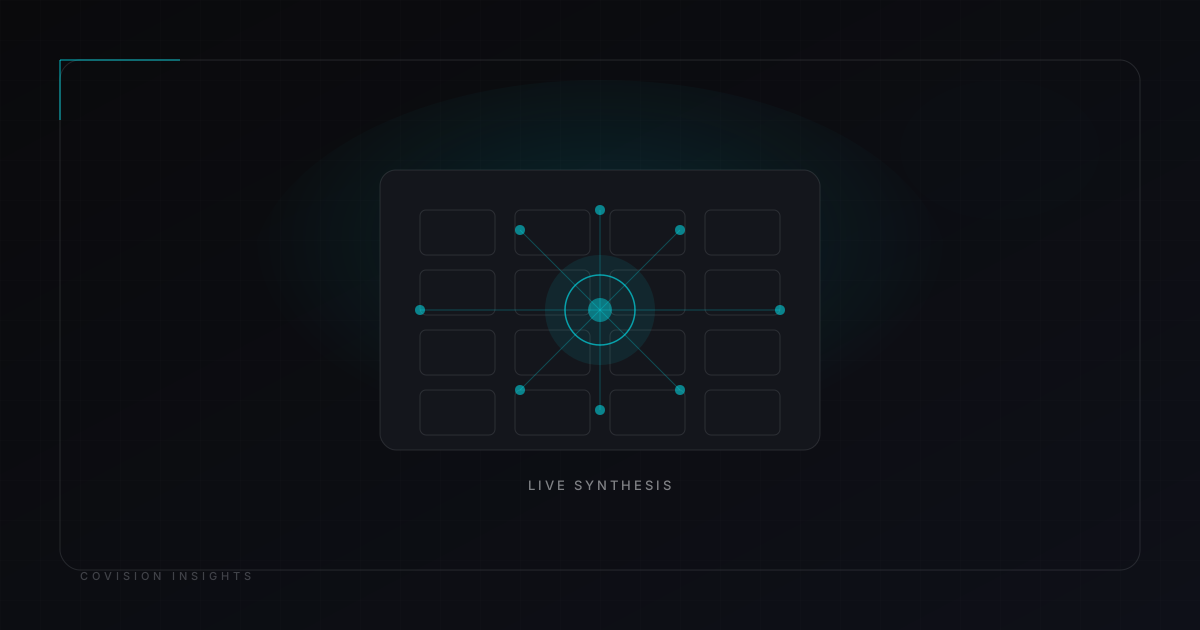
Live synthesis capability is most valuable here. When the system can surface thematic clusters across 20 individual submissions, the facilitation team can guide the group toward genuine insight rather than spending cognitive energy on manual organisation.
This phase often surfaces the most important conversation of the session: the moment when participants realise that two apparently different ideas are actually the same idea viewed from different functions, or that two ideas that seemed complementary are actually in direct competition for the same resources.
Synthesis Validation (30 minutes)
Before moving to prioritisation, give participants the opportunity to review how their ideas are represented in the synthesised output. This is a critical quality step, it catches misrepresentation before it is locked into the output document, and it reinforces participant ownership of the material.
Allow corrections and additions. The goal is not a clean document, it is an accurate one.
Phase 5: Prioritisation and Decision Framing
Duration: 60 minutes
Structured Prioritisation (35 minutes)
Run a structured scoring exercise against criteria aligned with the decision mandate. A simple three-dimension framework works well for most strategic alignment contexts:
- Strategic fit (1–5): How well does this idea align with stated strategic priorities?
- Feasibility (1–5): How achievable is this within the organisation's current resource envelope?
- Impact potential (1–5): How material is the expected outcome if this idea succeeds?
Each participant scores independently, then the group reviews the aggregate scores. Ideas with high consensus scores advance directly. Ideas with high variance scores, where participants disagree significantly, generate the most valuable discussion of the session.
High-variance ideas are where the strategic alignment work actually happens. They reveal genuine disagreements about priorities, risk tolerance, or resource assumptions that need to be resolved before any initiative can move forward.
Decision Framing (25 minutes)
For the top three to five ideas, the group frames the key decision questions that need to be resolved before the idea can advance: What approvals are required? What information is missing? Who owns the next step?
This framing converts the session output from a list of ideas into a decision-ready brief, a document that tells an executive not just what was proposed but what specific decision is required from them.
Phase 6: Output Review and Export
Duration: 30 minutes
Live Output Review (20 minutes)
Display the synthesised session output, ideally a structured summary of each prioritised idea with its score, key supporting rationale, and decision framing questions. Give participants ten minutes to review and flag any remaining inaccuracies.
This is the final quality gate. By this point, the output should be substantially complete and accurate. Minor corrections only.
Export and Distribution (10 minutes)
Generate and distribute the session output before participants leave the building. The output should include:
- An executive summary of the session mandate and top-line findings
- Structured summaries of each prioritised idea
- The prioritisation scores and any significant points of disagreement
- Clear next steps and decision owners
When executives receive a workshop output the same day as the session, with clear decision framing and participant-validated content, follow-through rates improve substantially. The context is intact. The momentum is live.
Closing: Making This Repeatable
The playbook above is not a one-time protocol. Its value compounds when it becomes a repeatable session architecture, one that participants recognise, understand, and can engage with efficiently from the outset.
Organisations that run repeated alignment workshops with consistent structure report faster context alignment at session open, higher-quality first-round contributions, and significantly reduced synthesis overhead between sessions.
Platforms like CoVision are built specifically to support this kind of structured, repeatable session design, handling intake, real-time synthesis, live output, and same-session export as core capabilities rather than add-ons. The facilitation discipline described above, paired with purpose-built infrastructure, is what separates alignment workshops that produce decisions from alignment workshops that produce decks.
The playbook is the method. The infrastructure is what makes it scalable.